Field Note 04
The Northern Frontier
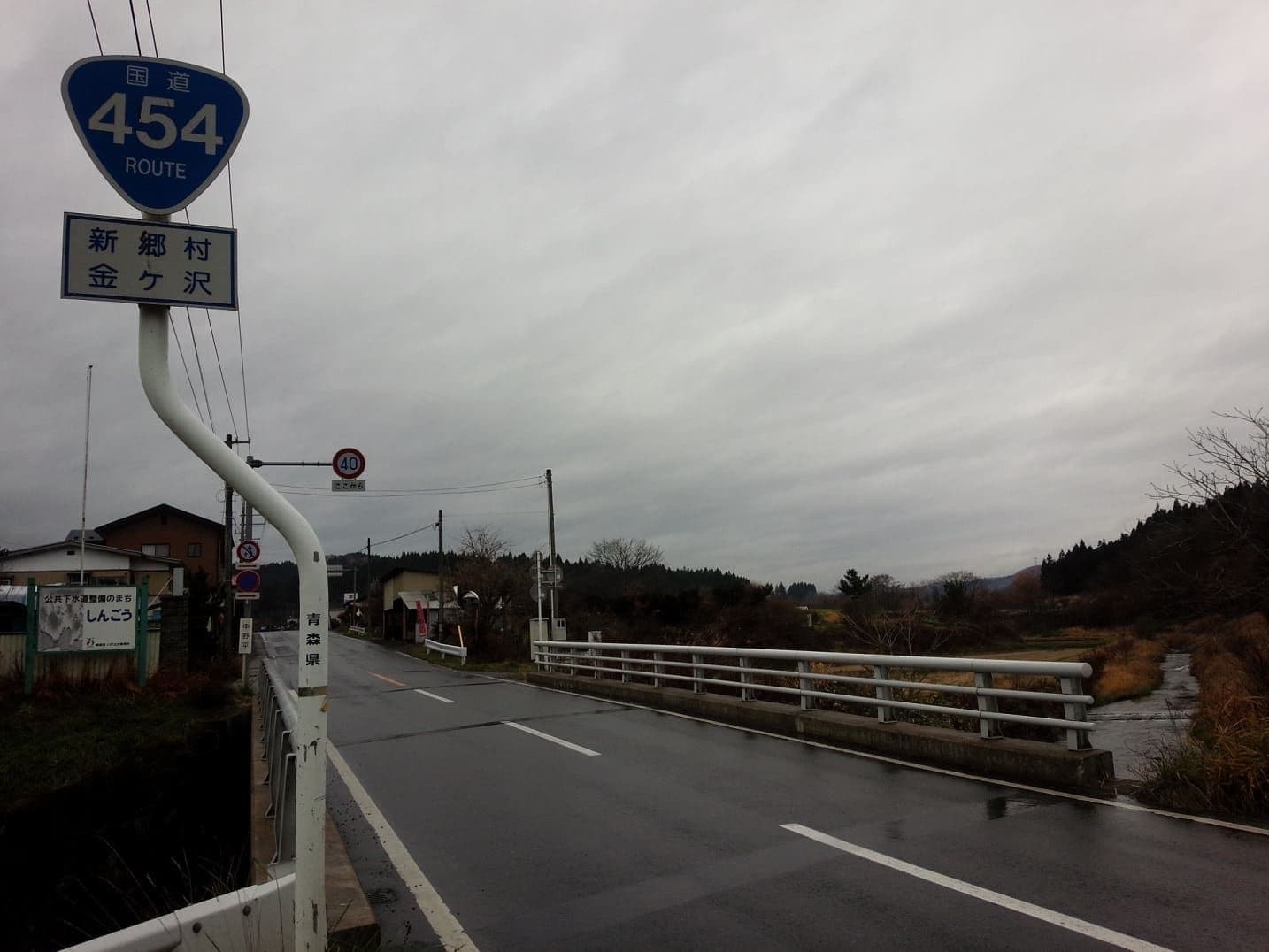
Photo: Route 454 Shingo by Shishi-netman · CC BY-SA 4.0 · web-optimized copy
Aomori Prefecture · 新郷村
Shingo sits in the Sannohe District of Aomori Prefecture, far from the centers that normally claim history. That distance is the point. The conduit belongs to a frontier landscape where wind, road, snow, and repetition erode certainty.
Field Fact
Factual Ground
The northern frontier frame begins with geography, not myth. Shingo is in Aomori Prefecture at the northern end of Honshu, and remoteness is best understood through actual travel distance, regional placement, and access patterns.
The Aomori Airport official site explicitly presents itself as a gateway to Northern Tohoku. JR East's Tohoku Shinkansen route map shows the rail spine running from Tokyo to Shin-Aomori, making the northbound structure of the trip clear in ordinary transport terms.
Together, these are enough factual anchors for frontier language: not because the region is inaccessible, but because reaching it involves a clear directional and logistical transition out of Japan's central urban corridor.
Site Context
Observed Site Conditions
The frontier quality builds incrementally. Long-distance rail to Aomori, local transfer decisions, road time, and thinning density all contribute to the sense that the journey is shifting into a different bandwidth.
Remoteness works best as a gradient rather than drama. The practical route remains legible and bookable; what changes is the amount of noise around the traveler and the amount of interpretive space the landscape creates.
That combination makes the north an unusually effective bridge between practical journey writing and canon language. The trip is real. The mood is real. The myth is the reading layered over that movement.
Conduit Reading
Conduit Reading
In canon terms, the frontier is not simply distance from Tokyo. It is the band of geography where the narrative can shed its urban framing and reconstitute itself as threshold logic: fewer interruptions, wider spacing, longer stretches of repeated terrain.
This is one of the places where heightened language still holds, because the factual layer is strong enough to carry it. The Tohoku route is real. The gateway framing is real. The conduit reading interprets why northbound movement can feel like more than travel inside the mythology.
Handled this way, the frontier framing becomes a cornerstone for both Conduit and Journey: one foot in transit reality, one foot in the canon's sense that the road itself becomes part of the interface.
Field Fact
This note should eventually combine real local data, place-specific references, and directly attributable context from public sources.
Field Note
Interpretive language can stay strange, but it should read as canon or editorial theory, not as a literal municipal claim.
Reference Rule
Use official Shingo and Aomori sources firstSite Conditions
Topography, weather, distance from major hubs, and seasonal shifts are part of the note, not background decoration.
Canonical Read
Each field note should interpret the landscape as conduit behavior: residue, pattern, pressure, and threshold logic.
Target Depth
Each field note should eventually expand into an 800 to 1,600 word article with local references, images, and outbound links.
Sources
Continue
Free guide
Hachinohe Station to the tomb, on one page.
A bilingual PDF with the Shinkansen to Hachinohe, the drive into Shingo, and the limited bus connection. Confirm the email, and the guide is in the message that follows.