The Source Text · Disputed Manuscripts · Shingo Village
The Takenouchi Documents
Every strange legend has a source text. For the claim that Jesus Christ survived the crucifixion and died in rural Japan, that source is the Takenouchi Documents — a set of disputed Japanese manuscripts that surfaced in the 1930s, claimed an ancient world government centered in Japan, and identified two earthen mounds in a farming village as the graves of Jesus and his brother. The originals were destroyed in World War II. What remains is a legend that put a village of fewer than 2,000 people on the map.
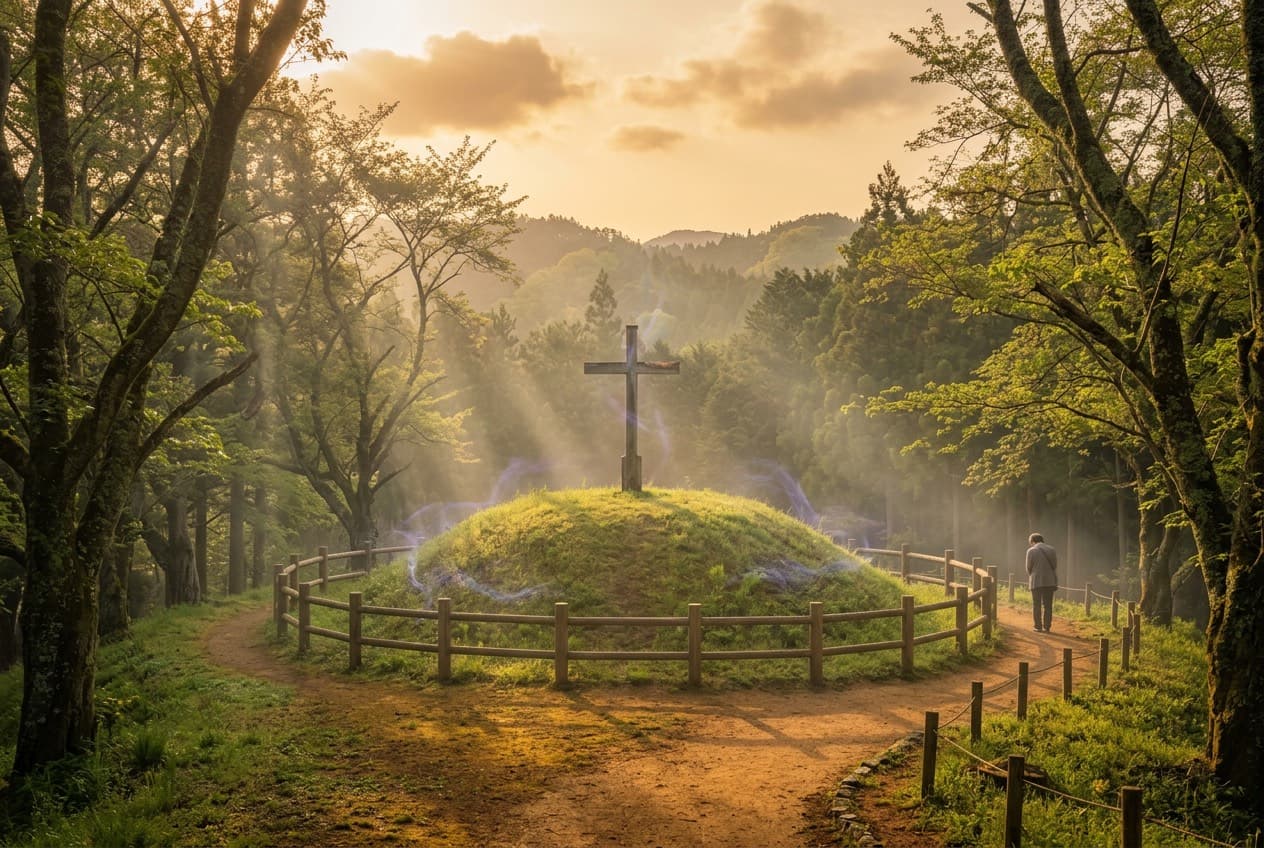
Christ Park · Shingo Village · The site Kiyomaro Takeuchi identified in 1935
Photo: Tomb of Christ in Japan by Mccunicano · CC BY-SA 4.0 · web-optimized copy
What Are the Takenouchi Documents?
The Takenouchi Documents (Takeuchi monjo, 竹内文書) are a set of manuscripts claimed to have been originally written in divine characters thousands of years ago by “the gods,” then rewritten approximately 1,500 years ago by Takenouchino Matori in a mixture of ancient Japanese and Chinese characters. The documents were said to have been preserved across generations by the Takenouchi family — descendants of the legendary hero Takenouchi no Sukune — and kept at the Koso Kotai Jingu shrine on Mount Omijin in Toyama Prefecture.
The documents present a radical alternative cosmology. In their telling, Japan was not merely one civilization among many but the seat of an ancient world government, located in the Hida Mountains, from which all human races originated. The world's great religious teachers — Jesus, Moses, Muhammad, Shakyamuni Buddha, Confucius, and Lao Tzu — were all said to have traveled to Japan for study and spiritual training. The Koso Kotai Jingu shrine was described as the most sacred place on Earth, dedicated to the ancestors of all mankind.
If the claims sound extraordinary, they are. The documents belong to a category of text that scholars call koshi koden— “ancient histories and traditions” — a genre of purportedly ancient Japanese manuscripts that emerged primarily in the modern period. Most are regarded as fabrications. The Takenouchi Documents are the most widely known example, largely because of one specific claim they contained: the location of Jesus Christ's grave.
Kiyomaro Takeuchi and the 1935 Discovery
The documents entered public awareness through Kiyomaro Takeuchi, who claimed to be a custodian of the manuscripts passed down through the Takenouchi family line. Kiyomaro was associated with the Koso Kotai Jingu shrine — a Shinto institution that served as the documents' institutional home and the center of their religious claims.
In 1935, Kiyomaro used the documents to identify two mounds near the village of Herai (now Shingo Village) in Aomori Prefecture as the graves of Jesus Christ and his younger brother Isukiri. The identification was not the result of archaeological excavation or historical research in any conventional sense. It was a textual claim: the documents said the graves were there, and Kiyomaro pointed to the mounds as confirmation.
The timing was not incidental. Japan in 1935 was deep in the grip of ultranationalist ideology. The military had occupied Manchuria four years earlier. State Shinto was being enforced as the official ideology. In this atmosphere, a document claiming that all world religions originated in Japan — that even the Christian messiah had recognized Japanese spiritual supremacy — carried a specific political charge.
What the Documents Claim
The Takenouchi Documents assert far more than a single burial site. Their central claims include:
- Jesus came to Japan at age 21 — during the years unaccounted for in the canonical Gospels — and studied theology and Japanese language for twelve years before returning to Judea at age 33 to teach.
- Isukiri died on the cross in his place — when the Romans arrested Jesus, his younger brother volunteered as a substitute. Isukiri was crucified at Golgotha while Jesus escaped eastward through Siberia.
- Jesus settled in Herai as a farmer — arriving at the port of Hachinohe, he traveled inland to Herai, adopted the Japanese name Daitenku Taro Jurai, married a local woman named Miyuko, fathered three daughters, and lived until the age of 106. The eldest daughter married into the Sawaguchi family, which still resides in Shingo today.
- Moses visited Japan and died there — the documents place Moses's grave on Mount Hodatsu in Ishikawa Prefecture, another claim with no supporting evidence.
- A pre-historical world civilization was centered in Japan — all races, all religions, and all languages originated from the Japanese archipelago, governed by a divine imperial line stretching back millions of years.
The Jesus narrative, in other words, was only one thread in a much larger fabric. The documents did not merely claim that Jesus came to Japan — they claimed that everyone came to Japan, because Japan was the origin of everything.
Wartime Seizure and the Destruction of the Originals
The documents' relationship with the Japanese authorities was complicated. While the ultra-ancient civilization claims aligned with the nationalist mood, the specific assertion that Christianity's founder had studied in Japan cut against the anti-Western sentiment of the era. The authorities were not interested in elevating Jesus, even as a student of Japanese wisdom.
The original documents were reportedly seized by the government during the war. According to Takenouchi family accounts, the manuscripts were subsequently destroyed during the firebombing of Tokyo — either in the air raids themselves or in the chaos that followed. No independent verification of this account exists. What is certain is that no originals survive, making any forensic analysis of the manuscripts' age, materials, or script impossible.
The destruction created a convenient paradox: the documents cannot be authenticated, but they also cannot be definitively disproven through physical examination. Believers point to the destruction as evidence of a cover-up. Scholars point to the lack of originals as the absence of evidence. The legend persists in the space between these positions.
Scholarly Reception: Modern Fabrication in an Ultranationalist Context
Mainstream historians, linguists, and religious studies scholars are in broad agreement: the Takenouchi Documents are a modern fabrication, not an ancient text. The consensus rests on several converging lines of evidence.
The documents belong to a broader movement known as choukodai bunmei-ron (超古代文明論, “ultra-ancient civilization theory”), which sought to establish Japan as the origin point of all human civilization. This was not a fringe position in 1930s Japan — it was an ideological current that ran parallel to, and sometimes intersected with, official state nationalism.
A peer-reviewed study published in the journal Religion (2016) compared the Takenouchi Documents to the SS Ahnenerbe's fabricated Germanic prehistory under Himmler, noting structural parallels in how both Japan and Nazi Germany constructed mythic national origins to legitimize imperial expansion. The comparison is instructive: both sets of claims dressed supremacist ideology in the language of ancient history.
The claim that all world religions and races originated in Japan is not a historical finding — it is a supremacist assertion. The documents carry embedded ultranationalist ideology from a specific and well-documented period of Japanese history. Scholars who have examined them treat them as artifacts of that period, not as windows into actual antiquity.
This does not mean the Shingo legend is without cultural significance. It means the legend's origin must be understood within its historical context, and its claims must be engaged as mythology rather than history. This site approaches the narrative through its canon — treating it as a living story, not a factual claim.
How the Documents Created the Shingo Legend
Without the Takenouchi Documents, there is no Jesus legend in Shingo. The connection between the village and Christianity did not arise from local oral tradition, archaeological discovery, or independent historical research. It originated entirely from Kiyomaro Takeuchi's 1935 identification of the mounds, based on what the manuscripts described.
Once the identification was made, however, the legend took on a life of its own. The village of Herai was renamed Shingo in 1955, but the Jesus connection persisted. Local authorities developed the tomb site into Christ Park, a maintained public space with two marked mounds, wooden crosses, and explanatory signage. The Denshokan museum was built adjacent to the tomb to house related materials and document the legend. And beginning in 1964, the village has held the annual Christ Festival (Kirisuto Matsuri) every June — a community event combining Shinto offerings, traditional lion dances, and the enigmatic Nanyadoyara folk dance.
The legend's persistence is pragmatic as much as it is cultural. Shingo is a small, remote farming village in the mountains of Aomori Prefecture. The Jesus tomb draws visitors who would otherwise have no reason to make the journey. The community has organized itself around the story not because residents necessarily believe Jesus is buried there, but because the story has become part of their municipal identity — a piece of local heritage that distinguishes them from every other village in Japan.
What Survives Today
The original Takenouchi Documents are gone. What survives is a constellation of copies, transcriptions, and secondary materials that keep the manuscripts in cultural circulation.
Copies and Transcriptions
Before the originals were destroyed, portions of the documents were transcribed and copied. These copies — of disputed fidelity — have circulated in Japanese esoteric and alternative-history communities since the postwar period. Some have been published in Japanese and are accessible through academic libraries and specialist bookshops. Researchers working with these materials note that the copies themselves cannot be independently verified against originals that no longer exist.
The Denshokan Museum
The most accessible collection of Takenouchi-related materials is at the Denshokan in Christ Park, Shingo Village. The museum displays historical documents, local artifacts, farming implements, and a video presentation introducing the village's legends and folklore. It is the closest a visitor can come to encountering the Takenouchi tradition in its physical context — the actual landscape that Kiyomaro pointed to when he said the graves were here.
The Koso Kotai Jingu Shrine
The Koso Kotai Jingu shrine in Toyama Prefecture — the institutional home of the documents — continues to operate. The shrine maintains its connection to the Takenouchi tradition, though its public profile is modest compared to major Shinto institutions.
Online and Academic Sources
The documents have attracted attention from researchers studying Japanese nationalism, pseudohistory, and new religious movements. The Wikipedia article on the Takenouchi Documents provides a starting point, and the 2016 Religion journal study offers the most rigorous academic treatment available in English. Several Japanese-language books examine the documents in detail, though most adopt either a credulous or a dismissive stance rather than a neutral one.
Frequently Asked Questions
What are the Takenouchi Documents?
The Takenouchi Documents (Takeuchi monjo) are a set of disputed Japanese manuscripts claimed to have been preserved by the Takenouchi family at the Koso Kotai Jingu shrine in Toyama Prefecture. They present an alternative cosmology in which Japan was the origin of all human civilization and all world religions. The documents surfaced publicly in the 1930s and are universally regarded as pseudohistory by mainstream scholars.
Are the Takenouchi Documents real or fake?
Mainstream scholars classify them as a modern fabrication from the 1930s, not an ancient text. They emerged during a period of intense Japanese ultranationalism and belong to a broader movement called choukodai bunmei-ron (ultra-ancient civilization theory). The originals were reportedly destroyed during the firebombing of Tokyo in World War II, making independent verification impossible.
What do the Takenouchi Documents say about Jesus?
According to the documents, Jesus first came to Japan at age 21, studied for twelve years, then returned to Judea. When the Romans arrested him, his brother Isukiri died on the cross in his place. Jesus escaped through Siberia and settled in Herai (now Shingo Village), where he married, raised three daughters, and lived to 106. These claims form the entire basis of the Tomb of Christ in Aomori Prefecture.
Where can I see the Takenouchi Documents today?
The originals no longer exist. Copies, transcriptions, and related materials can be viewed at the Denshokan museum in Christ Park, Shingo Village. The museum is open 9 AM to 5 PM, closed Wednesdays, and shut from early November through late April. Admission is 500 yen. For travel planning, see the pilgrimage guide.
How did the Takenouchi Documents lead to the Tomb of Christ in Japan?
In 1935, Kiyomaro Takeuchi used the documents to identify two earthen mounds near Herai as the graves of Jesus and Isukiri. The village subsequently developed the site into Christ Park, built the Denshokan museum, and has held the annual Christ Festival every June since 1964. The tomb remains a maintained visitor destination regardless of the documents' disputed authenticity.
Next Step
The documents pointed to a village. The village is still there.
Read the full legend of Jesus in Japan, explore the mythology through the canon, or plan the journey north to Shingo.