The Legend · Shingo Village · Aomori Prefecture
Did Jesus Go to Japan?
Did Jesus go to Japan? According to a legend preserved in Shingo Village, Aomori Prefecture, he did. The story holds that Jesus Christ survived the crucifixion, fled east through Siberia, and settled in a remote farming village in northern Japan, where he married a local woman, raised three daughters, and died at the age of 106. His tomb, marked by a simple earthen mound and a wooden cross, still stands on a quiet hillside in a village of fewer than 2,000 people. The legend is almost certainly not true. But the tomb is real, the village is real, and every June the community gathers to honor the story that put their village on the map.
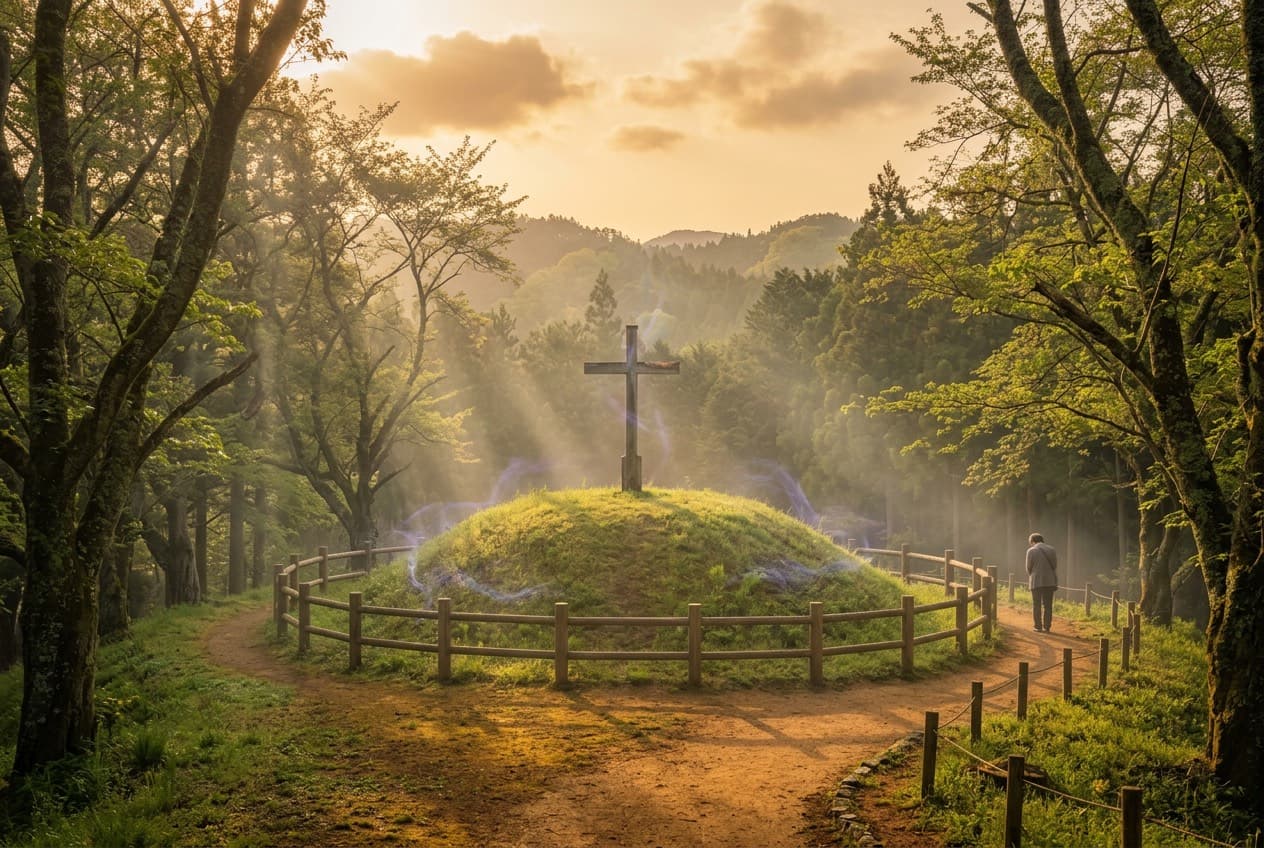
Christ Park · Shingo Village · Sannohe District · Aomori Prefecture
Photo: Tomb of Christ in Japan by Mccunicano · CC BY-SA 4.0 · web-optimized copy
The Legend: Jesus Survived and Walked East
The story, as told in Shingo, follows a specific narrative. Jesus first came to Japan at age 21, during the years unaccounted for in the canonical Gospels. He spent twelve years studying theology and Japanese language under a master before returning to Judea at age 33 to teach what he had learned.
When the Romans arrested him, his younger brother Isukiri volunteered to take his place on the cross. While Isukiri died at Golgotha, Jesus escaped. Carrying one of Isukiri's ears and a lock of the Virgin Mary's hair, he traveled north through Siberia, crossed to Alaska, and eventually arrived at the port of Hachinohe on the Pacific coast of northern Honshu. From there, he made his way inland to the village then known as Herai — now Shingo.
In Herai, Jesus adopted the Japanese name Daitenku Taro Jurai. He married a local woman named Miyuko, fathered three daughters, became a garlic and rice farmer, and lived quietly until his death at 106. The eldest daughter married into the Sawaguchi family, which still resides in Shingo today. The legend says Jesus was buried on the hillside that now forms Christ Park, and Isukiri's remains were interred in an adjacent mound.
The Takenouchi Documents: Origin of the Claim
The story of Jesus in Japan traces to a single source: the Takenouchi Documents (Takeuchi monjo), a set of manuscripts claimed to have been written in divine script thousands of years ago and rewritten approximately 1,500 years ago by Takenouchino Matori. The documents were said to have been preserved by the Takenouchi family and kept at the Koso Kotai Jingu shrine on Mount Omijin in Toyama Prefecture.
In 1935, a man named Kiyomaro Takeuchi used the documents to identify two mounds near the village of Herai as the graves of Jesus and Isukiri. The documents present a far larger claim than just the Jesus connection: they assert that Japan was the seat of an ancient world government, that all the world's great religious teachers — Moses, Muhammad, Buddha, Confucius, and others — traveled to Japan for training, and that all human races originated from the Japanese.
The documents emerged during a period of intense Japanese ultranationalism in the 1930s. They belong to a broader movement known as choukodai bunmei-ron (ultra-ancient civilization theory), which sought to establish Japan as the origin point of all human civilization. A peer-reviewed study in the journal Religion(2016) compared the documents to the SS Ahnenerbe's fabricated Germanic prehistory, noting structural parallels in how both Japan and Nazi Germany constructed mythic national origins.
The original documents were reportedly destroyed during the firebombing of Tokyo in World War II, making independent verification impossible. Mainstream scholars universally classify them as pseudohistory. The site approaches the legend through its canon as mythology, not as a historical claim.
What You Find at Shingo Today
Regardless of what you make of the legend, the sites in Shingo are real, maintained, and open to visitors. Here is what you will find.
The Tomb of Christ (Kirisuto no Haka)
The Tomb of Christ site consists of two earthen mounds on a wooded hillside in Christ Park. The eastern mound is said to be the grave of Jesus. The western mound is said to hold Isukiri's ear and a lock of Mary's hair. Each is marked by a simple wooden cross. The grounds are grassy, open, and peaceful. Admission to the outdoor site is free, and it is open year-round during daylight hours, though winter visits are impractical due to heavy snowfall. The coordinates are approximately 40.5133° N, 141.1556° E.
The Denshokan Museum
The Denshokan is a small museum within Christ Park documenting the legend and the cultural history of the former Herai area. Exhibits include historical documents, local artifacts, farming implements regarded as folk art, and a video presentation introducing the village's legends and folklore. The museum is open 9:00 AM to 5:00 PM, closed Wednesdays, and shut entirely from early November through late April. Admission is 500 yen for adults.
Christop
The Christop is a small rest area and shop near the tomb site. It serves as a practical stopping point for visitors and sells local goods, including Shingo's famous garlic products.
The Christ Festival (Kirisuto Matsuri)
Every year on the first Sunday of June, Shingo holds the Christ Festival. Running annually since 1964, it is a blend of Shinto, folk, and commemorative elements. Shinto tamagushi (sacred tree branches) are offered at the tomb. A traditional lion dance is performed. And villagers dance the Nanyadoyara — a local folk dance whose lyrics are in a language no living speaker fully understands. The festival functions as a community gathering, not a religious service, and visitors are welcome.
The Sawaguchi Family and the Star of David Crest
The Sawaguchi family of Shingo Village claims descent from Jesus through the eldest of his three daughters. Their family crest, displayed on the exterior wall of their home, is said to resemble the Star of David — cited by legend proponents as evidence of Hebrew lineage.
Some accounts claim the Sawaguchi family displays physical characteristics unusual in the region, though these claims are vague and unverified. The family serves as local stewards of the tradition. Their engagement with the legend appears pragmatic and community-oriented rather than doctrinaire. They are real people living in a real village, and should be understood in that context rather than as characters in a mythology.
The Nanyadoyara Chant
One of the more unusual elements of the Shingo legend is the Nanyadoyara — a folk chant performed at the Christ Festival and at Bon Festival celebrations across the Aomori-Akita border region. The lyrics are in a language that no living speaker can fully translate or understand.
Legend proponents claim the words sound like Hebrew, and that the chant may be a surviving fragment of ancient Israelite worship carried to Japan. Linguists have not confirmed this connection. The chant is common across a broad geographic area and predates the 1935 “discovery” of the Jesus tomb, which makes a direct link to the Takenouchi narrative difficult to sustain. Regardless of its origins, the Nanyadoyara is a distinctive regional tradition and one of the more memorable elements of a visit during festival season.
The Scholarly Perspective
Mainstream historians, theologians, and linguists are in broad agreement: the Takenouchi Documents are a modern fabrication, and there is no credible evidence that Jesus traveled to Japan. The documents carry embedded Japanese ultranationalist ideology from the 1930s, and their central claim — that all world religions and races originated in Japan — is a supremacist assertion, not a historical finding.
The folk etymological connection between “Herai” (the old village name) and “Heburai” (the Japanese word for Hebrew) is audible but linguistically unfounded. The characters used to write Herai (戸来) have a straightforward reading in Japanese: “door” and “come.” The Sawaguchi family crest's resemblance to the Star of David, and the unintelligible lyrics of the Nanyadoyara chant, are intriguing but unverified by independent research.
The Shingo legend belongs to a wider global pattern of “Jesus survived and traveled East” narratives. The Ahmadiyya Muslim tradition places Jesus's tomb in Kashmir. Nicolas Notovitch claimed in 1894 that a Tibetan manuscript described Jesus studying in India. The swoon hypothesis — that Jesus did not die on the cross but lost consciousness and was later revived — has circulated since the 18th century. Multiple Gnostic texts, including the Second Treatise of the Great Seth, describe a substitution at the crucifixion where someone else died in Jesus's place. In Islamic tradition, the Quran states that Jesus was “neither killed nor crucified — it was only made to appear so.”
The Shingo version is unique in placing Jesus not just in the East, but specifically in rural northern Japan — and in having a living community that has organized itself, however pragmatically, around that claim.
Why People Still Visit
Most people who visit Shingo do not believe Jesus is buried there. They come because the story is strange enough to justify the trip, and because the place itself — a quiet farming village in the mountains of Aomori — delivers something that more polished tourist routes do not: a landscape that feels like it belongs to a different version of Japan.
The legend functions as a narrative engine. It gives a traveler a reason to drive into the deep interior of northern Tohoku, past rice paddies and cedar forests and mountain passes that most visitors to Japan never see. The tomb itself is modest. The museum is small. But the combination of a genuinely bizarre story and an authentically remote setting produces a visit that is difficult to forget.
Shingo also sits within reach of Lake Towada, Oirase Gorge, and the Hakkoda Mountains — some of the most dramatic natural scenery in Japan. A trip to the tomb can anchor a broader itinerary through a region that rewards travelers who are willing to go beyond the standard circuits. For practical planning and travel guidance, the journey guide covers routes, lodging, and seasonal considerations.
Frequently Asked Questions
Did Jesus really go to Japan?
According to a local legend in Shingo Village, Aomori Prefecture, Jesus survived the crucifixion and traveled east through Siberia to Japan, where he lived as a rice farmer until the age of 106. The legend originates from the Takenouchi Documents, which mainstream scholars regard as a modern fabrication from the 1930s. There is no accepted historical evidence that Jesus traveled to Japan. However, the legend has become a genuine part of Shingo's community identity and cultural heritage.
Where is the Tomb of Christ in Japan?
The Tomb of Christ (Kirisuto no Haka) is located in Christ Park in Shingo Village, Sannohe District, Aomori Prefecture, in northern Japan. The site consists of two earthen mounds on a wooded hillside. The outdoor grounds are free to visit year-round during daylight hours. The nearest city with Shinkansen access is Hachinohe, approximately 60 km away.
What are the Takenouchi Documents?
The Takenouchi Documents (Takeuchi monjo) are a set of manuscripts claimed to have been preserved by the Takenouchi family at a shrine in Toyama Prefecture. They present an alternative cosmology in which Japan was the origin of all human civilization and all world religions. The documents surfaced in the 1930s during a period of Japanese ultranationalism and are universally regarded as pseudohistory by mainstream scholars. The originals were reportedly destroyed during the firebombing of Tokyo in World War II.
Is there evidence Jesus went to Japan?
There is no accepted archaeological, textual, or historical evidence. The claim rests entirely on the Takenouchi Documents. Circumstantial claims — the folk etymology connecting Herai to Hebrew, the Sawaguchi family crest's resemblance to the Star of David, and the unintelligible Nanyadoyara lyrics — have not been verified by independent scholars. The legend is best understood as a cultural phenomenon rather than a historical claim.
How do I visit the Jesus tomb in Japan?
Take the Tohoku Shinkansen to Hachinohe Station, then drive approximately 60 km (1 to 1.5 hours) to Shingo Village. A rental car is strongly recommended. The tomb grounds are free and open year-round, though winter access (December through March) is impractical due to heavy snow. The adjacent Denshokan museum is open 9 AM to 5 PM, closed Wednesdays, and shut from early November through late April. Admission is 500 yen. The best months to visit are June (Christ Festival), July through August, and late September through October. See the full journey guide for detailed planning.
What is the Christ Festival in Shingo?
The Christ Festival (Kirisuto Matsuri) is an annual community event held on the first Sunday of June at Christ Park in Shingo Village since 1964. It features Shinto tamagushi offerings at the tomb, traditional lion dances, and the Nanyadoyara folk dance. It functions as a community celebration rather than a religious service, and visitors are welcome to attend.
Next Step
Read the legend, then plan the trip north.
The canon tells the full story across five epochs. The journey guide gets you to Shingo. The village does the rest.