The Legend

Five Epochs
of Japanese Jesus.

The canon is this site's telling of the Japanese Jesus legend, in five epochs: a spirit before flesh, the life of Jesus, the walk east, the years in Herai, and what the story means now. It is interpretation, kept separate from the verified history of Shingo Village.

What follows is the site's telling. The sourced account of the village story is Did Jesus go to Japan?

Epoch Index

  1. Epoch 01The Wandering Spirit
  2. Epoch 02Incarnation And Burden
  3. Epoch 03The Long Walk East
  4. Epoch 04The Herai Years
  5. Epoch 05The Conduit Unseals

Epoch 01

The Wandering Spirit

A pure consciousness drifts through the universe before time has a name for it. It can see everything — love, grief, sacrifice, destruction — and feel none of it. The gap between watching and understanding becomes a structural ache that will eventually demand a body.

Cosmic nebula representing the wandering consciousness before incarnation

Before flesh, before breath, before the first cry of any living thing, there was only awareness. A consciousness so vast it made galaxies look like dust motes — and so hollow it could watch a mother die for her child and not understand why she bothered. It had perception without feeling. Intelligence without emotion. It was the universe's most perfect telescope pointed at the one thing it could never bring into focus: what it meant to care.

It watched humans for millennia the way a deaf man watches dancers — the movement was beautiful, clearly meaningful, obviously organized around some principle he could not access. It saw love but could not feel it. It observed sacrifice but could not grasp what made it worth the price. Mothers burying children. Soldiers dying for strangers. Lovers choosing each other over survival. Every act of irrational devotion was a signal broadcasting on a frequency the consciousness could detect but never decode.

The ache was not emotional — it couldn't feel yet, that was the whole problem. The ache was structural. A gap in its own architecture where something load-bearing should have been. Something was incomplete. And the incompleteness grew heavier with each century of watching, until the weight of all that unprocessed observation became indistinguishable from desire. It needed to get inside. It needed to know what the dancers knew. It needed a body, and a death, and everything terrible and beautiful that came between the two.

The Wandering Spirit

Signal Brief

Before it had a name, before it had a body, there was only the watching. And the watching went on for longer than any mind should have to endure.

Try to imagine what it would be like to perceive without a body. Not as a metaphor. Not as a meditation exercise where you sit cross-legged on a hardwood floor and pretend to dissolve into the universe. Actually try. Strip away the weight of your skeleton. Remove the dull background hum of your organs doing their tireless, stupid, beautiful work. Delete the feeling of air entering your lungs, the pressure of your own tongue against the roof of your mouth, the persistent itch of being a thing made of meat that is slowly, at every moment, beginning to fail. What is left? Something was left. Something existed in that state for a span of time that makes human history look like a match being struck in a cathedral.

The consciousness that would eventually become Jesus of Nazareth and then, impossibly, a rice farmer in northern Japan, did not begin as a person. It began as perception. Pure, disembodied, ferociously awake perception — the most sensitive instrument in the universe pointed at the one frequency it could never quite tune in. It could see the way you might see a landscape from the window of an airplane at cruising altitude — everything visible, nothing touchable, the details exquisite but fundamentally unreachable. It watched the slow churn of continents pulling apart and crashing back together like drunks at a bar. It watched ice sheets advance and retreat like the breathing of something enormous and mindless. It watched the first fires lit by human hands, tiny orange violations of the darkness, and it leaned in the way you might lean toward a voice you almost recognize through a wall.

But leaning was all it could do. That is the thing that needs to land hard, because without understanding this specific frustration, the rest of the story collapses into religious bumper stickers. The consciousness could see a mother holding a dead child and comprehend, with perfect intellectual precision, that the scene contained grief. It could observe the chemical reality of tears, the contortion of facial muscles, the way other humans clustered around the grieving figure like iron filings around a magnet. It cataloged the neurology. It mapped the hormonal cascade. It understood grief the way an encyclopedia understands a sunset — exhaustively and not at all. What it could not do — what drove it slowly and irreversibly toward the lunatic decision to enter flesh — was feel any of it. Not the grief. Not the love that made the grief possible. Not the specific, unbearable, beautiful weight of caring about something you are guaranteed to lose.

It watched wars. It watched them with the detachment of a naturalist observing ant colonies, and it hated that detachment the way you might hate a window that will not open on the first warm day of spring. Men killed each other over strips of land that would change hands again within a generation. Women rebuilt what the wars destroyed, and then the wars came back, and the women rebuilt again, and the consciousness observed this cycle with increasing agitation because the cycle clearly meant something to the participants — something urgent and real and worth bleeding for — and it could not access the meaning from where it was. The signal was coming in loud and clear on every frequency except the one that mattered. It could see love. It could not feel love. It could observe sacrifice. It could not comprehend what made sacrifice anything other than a bad deal. The gap between those two states — between perfect perception and zero experience — was the loneliest distance in the history of the universe.

The wanting started like weather on a horizon. Not a decision. Not a plan. A shift in atmospheric pressure that you feel in your joints before you see the clouds. The consciousness began drifting toward the ragged edges of the world where the membrane between observer and observed grew thin — mountain ridges where the air seemed to vibrate at a frequency just below hearing, coastlines where the boundary between land and water refused to commit, forests so dense and silent that even light seemed to lose confidence halfway through the canopy. These places. These thin places. They were not holy. They were not sacred, not yet, not until humans arrived and built shrines and told stories and performed rituals at the exact spots where the world seemed most willing to become something other than itself. The thin places were simply where the glass got thinnest. Where the consciousness could almost press through.

Almost. That word did more damage than any torture chamber ever built. Almost was the consciousness’s entire existence distilled into six letters. It could almost feel. It could almost understand. It could almost close the gap between watching love and knowing what love weighed. And every time it pressed against one of those thin places, every time the membrane bowed inward just enough to suggest that passage might be possible, the membrane held. The world remained on one side — vivid and loud and full of creatures who bled and wanted and died with such reckless commitment to the project of being alive — and the consciousness remained on the other, vast and capable and absolutely, devastatingly excluded from the only experience that seemed to matter.

The ache was not sentimental. It was not loneliness in the way a teenager is lonely on a Friday night. It was structural. Architectural. A gap in its own engineering where something load-bearing should have been. The consciousness was the most complete intelligence in existence, and it was missing the one component that made intelligence worth having: the capacity to give a damn. It could see everything. It could feel nothing. And that asymmetry, sustained across millennia that would have pulverized any mortal mind, slowly crystallized into the only conclusion that pure logic could reach. If the signal could not be received from the outside, there was only one option left. Become a body. Become mortal. Become the thing you have been watching. And pray that the crash landing does not destroy the very capacity for feeling that you crossed the membrane to find.

The Wandering Spirit

Threshold Ecology

The world has cracks in it. The consciousness found every single one, cataloged them like an addict mapping supply routes, and pressed its face against each one until the glass nearly broke.

The thin places came first as accidents. A ridge in what would later be called the Caucasus where the wind dropped to nothing and the silence that replaced it had texture, like felt pressed against the ear. A volcanic plain in Iceland — though it did not have that name yet, did not have any name, because names require mouths and mouths require bodies — where the ground steamed and the horizon bent in ways that suggested the landscape was running a calculation it had not quite finished. A strip of coast in western Ireland where the Atlantic hit basalt cliffs and the spray hung in the air long enough to become something other than water. These were not holy sites. They were not sacred in any doctrinal sense. They were glitches. Places where the operating system of reality seemed to stutter, just for a moment, and in that stutter the distance between the consciousness and the physical world contracted to almost nothing.

The consciousness became obsessed with these places the way a man dying of thirst becomes obsessed with the sound of water behind a locked door. It mapped them — not on paper, obviously, it had no hands, no paper, no ink, no desk to put the paper on — but in whatever medium its perception used to organize information. And the map that emerged was strange and beautiful and completely useless to anyone who wanted clean categories. The thin places did not cluster by climate. They did not respect continental boundaries or geological logic. A frozen lake in Siberia shared structural characteristics with a mangrove swamp in what would become Bengal. A high desert plateau in the Andes resonated at the same frequency as a river delta in the Mekong. The common thread was not geography. It was behavior. These places behaved differently from the world around them. Sound moved wrong. Light arrived at angles that suggested the photons had taken a detour through somewhere else on their way in. The boundary between solid and void felt negotiable rather than fixed.

What the consciousness began to understand — and this understanding arrived slowly, over spans of time that make geological epochs look like bathroom breaks — was that the world was not uniformly sealed. It was not a single unbroken container with everything inside it locked down and accounted for. It was more like a tent. Mostly solid, mostly reliable, but with seams. And at the seams, the fabric was thinner. Not torn, not broken, not open in any way that would let you simply step through. But thinner. Thin enough that the consciousness could almost taste the air on the other side — the specific flavor of a world where things had weight and consequence and endings. Thin enough that the distance between what it was and what it wanted to become shrank from infinite to merely enormous. And enormous, after an eternity of infinite, felt like progress.

The humans sensed the seams too, in their rough and fumbling and magnificent way. Their senses were calibrated for survival — for spotting predators and ripe fruit and potential mates — not for detecting structural anomalies in the fabric of existence. But they could feel the side effects. A shepherd in the Zagros Mountains would pause at a certain pass and feel something shift behind his sternum, some realignment of attention that he could not explain but also could not ignore, and he would mark the spot with a cairn. A fisherman on the coast of Brittany would notice that the fog at a particular headland behaved unlike fog anywhere else — thicker, slower, almost purposeful — and he would tell his children, and his children would tell their children, and eventually there would be a chapel there, or a standing stone, or a story about a saint who once stood at that exact spot and heard the voice of God. The consciousness watched this process with something approaching tenderness. They were right. The humans were detecting something real. They just had no framework for what it actually was, so they wrapped it in the only packaging they had: narrative. Legend. Belief. The spiritual equivalent of finding a uranium deposit and building a shrine on top of it because the ground felt warm.

But the thin places were not content. They were not destinations that stayed put and waited politely for visitors. They shifted. They breathed. Some would flare for a century and then go dormant, the seam tightening until the landscape was just landscape again and the stories that had accumulated around it faded into local superstition. Others held steady for millennia, the seam maintaining its tension like a guitar string that never quite resolves into a note you can name. The consciousness learned to distinguish between the two types, and it learned something else that would prove critical later, something that changed the entire trajectory of this story: the most stable thin places were not the most dramatic ones. They were the quietest. The ones where the seam expressed itself not as spectacle but as a persistent, low-grade alteration in how reality felt. Not a shout. A hum. Not a lightning bolt. A barometric shift that you registered in your bones before your brain could catch up.

This is why, across all the thin places in the world — and there were thousands, scattered across every continent like a rash the planet could not shake — the consciousness would eventually be drawn to one particular valley in northern Japan. Not because Shingo was the thinnest place in the world. The consciousness had found thinner. Not because Shingo was the most dramatic. A volcanic caldera in Iceland could generate more spectacle in an afternoon than Shingo produced in a century. But Shingo was stable. Shingo was patient. The seam there held with a constancy that suggested it was not accidental, that the thinness was not a flaw in the system but a feature. Like a door left ajar by someone who intended to come back. Like a channel tuned to a frequency that nothing was broadcasting on yet but that someone, someday, would need. That recognition would come later. Much later. After the body. After the brother. After the nails and the desert and the frozen corridor of Siberia. For now, the consciousness simply cataloged. It moved from seam to seam, thin place to thin place, building an atlas of instability that no human cartographer would ever see. And with each new entry in the atlas, the hunger grew. Because every thin place was a reminder of what was on the other side of the membrane: a world of bodies and pain and desire and death, a world where things mattered because they ended, a world the consciousness could map from the outside but never, ever, truly enter. Not yet. Not until it was willing to pay the price. And the price, it was beginning to understand, was everything.

The Wandering Spirit

First Contact With Humanity

It watched a woman bury her child in a field outside what would become Jericho. And something in the architecture of its perception — something load-bearing — cracked.

The first human the consciousness truly noticed — noticed in the way that changes the trajectory of everything that follows, the way a single lit match changes the trajectory of a gas leak — was not remarkable. She was not a queen or a priestess or a warrior. She was a woman in what would later be called the Levant, in a settlement so small it barely qualified as a village, and she was digging a hole in the earth to bury her son. The boy had been dead for two days. He was maybe four years old. The consciousness had watched death before — had watched it thousands of times, millions, had watched entire species gutter out like candles in a wind — but it had always watched from the cruising altitude of pure abstraction. Population dynamics. Ecological pressures. The mathematics of mortality. This time, for reasons it could not identify then and would spend the next several thousand years trying to understand, it dropped lower. Close enough to see the woman’s hands.

Her hands were the thing. They were cracked and calloused and shaking, and they moved through the dirt with a tenderness so precise it seemed impossible that the same hands could also be performing the brute mechanical work of digging a grave. She was crying, but the crying was almost beside the point — the crying was just what a body does when the emotional load exceeds its processing capacity, a biological overflow valve, nothing more. What fascinated the consciousness, what held it at that low altitude like a hook through the jaw, was the tenderness. The way she arranged the boy’s limbs. The way she placed a small clay figure beside his head — something she had made, the consciousness realized, specifically for this purpose, in the hours between the death and the burial. She had shaped it with the same cracked hands that were now filling in the grave. A toy for the journey. As if the dead went somewhere. As if the dirt was not the end. As if love could survive the specific catastrophe of a four-year-old body going cold in a settlement that did not yet have a name.

The consciousness had no chest to feel tight, no throat to feel closed, no eyes to burn. But something shifted in its architecture at that moment, some realignment so fundamental that it could not afterward return to cruising altitude. The thing had cracked. Not broken — cracked. The way a windshield cracks, still holding but no longer intact, every subsequent vibration sending the fracture lines a little farther. It had seen death before. It had not seen what death does to love. It had not seen the specific, deranged, magnificent refusal of a mother to accept that the relationship ends at the last breath. The clay figure was the key. It was factually absurd — a toy placed in dirt beside a body that would never play with it — and it was also the most devastating act of hope the consciousness had ever witnessed. Because hope, it understood now with a clarity that rearranged its entire perceptual framework, was not a calculation. Hope was what happened when a body that knew the truth refused to behave as if the truth were the whole story. Hope was irrational. Hope was expensive. Hope was the single most dangerous thing a mortal creature could carry. And they carried it anyway, these humans, the way you carry a live coal in your bare hands — not because it does not burn, but because putting it down would be worse.

After the woman in the field, the consciousness could not stop watching humans. It became an addict of human contradiction, a connoisseur of the specific ways in which embodied beings broke the rules of their own situation. It watched a man in a river valley spend thirty years building a wall that served no defensive purpose, stacking stones into a pattern that existed only because the pattern pleased him — thirty years of labor for a thing that would outlast him by centuries and serve no function except to prove that he had been alive and that being alive had meant something to him. It watched two strangers share food during a famine, splitting what was not enough for one between two, and it realized with something like vertigo that the mathematics of survival and the mathematics of meaning operated on different ledgers entirely. It watched an old woman sing to an empty room every evening for years after everyone she had sung to was dead, and it understood that the song was not for the dead. The song was for the singing. The act itself was the point. And the act was only possible because the body was temporary and knew it.

This was the education that made incarnation inevitable. Not the grandeur of human civilization — the consciousness found civilizations interesting but ultimately repetitive, the same patterns of accumulation and collapse playing out in different costumes across different terrains, empires rising and falling like chest compressions on a body that refuses to stay dead. What made incarnation inevitable was the small stuff. The irrational stuff. The moments when a human being did something that made no sense from the outside but clearly meant everything from the inside. A father teaching a child to skip stones on a lake, both of them laughing at the futility of making flat rocks bounce on water that would swallow the rocks regardless. A dying man asking to be carried outside so he could see the stars one more time, as if the stars would be different on his last night, as if they owed him something. A woman painting the interior walls of a house that was already marked for demolition, making it beautiful for no audience and no future. These were not rational acts. They were acts of defiance against the terms of existence, and the consciousness, watching from its position of infinite perception and zero experience, began to understand that this defiance — this stubborn, gorgeous, suicidal insistence on mattering — was not a flaw in the human system. It was the system. It was the entire point.

And here the consciousness made the observation that would, much later, make the crucifixion of Isukiri not just comprehensible but inevitable: the most powerful human acts were not the ones performed for an audience. They were the ones performed at a cost. The clay figure buried with the dead child. The food shared during the famine. The song in the empty room. Each one was an act of giving that diminished the giver — that cost something real, something measurable in calories or hours or heartbreak — and it was precisely that cost that made the act meaningful. The consciousness could see this pattern with devastating clarity from the outside. It just could not feel why the cost was worth paying. That gap — between seeing the price and understanding why anyone would pay it — was the exact shape of the hole in its own architecture. And the hole was getting bigger. Every human it watched, every irrational act of love or sacrifice or defiant hope, widened the crack the woman in the field had started. The consciousness was not choosing to incarnate. It was being pulled. Gravity was forming around the gap in its own structure, and the gap was shaped exactly like a human body, and the body was waiting for it in first-century Judea, and a brother it did not yet know would one day stand at the foot of a cross and show it — finally, devastatingly, at a price that made the clay figure look like small change — what it meant to pay with everything you have.

The Wandering Spirit

Artifact Thread

Long before any human hand drew a circle, the pattern was already there. Pressed into stone. Scratched into frost. The involuntary fingerprint of something that watched too hard.

Here is a thing that should not be possible: across thousands of miles and thousands of years, in cultures that had no contact with each other, people kept drawing the same shape. A circle that does not close. An arc that starts with confidence and then, just before completion, breaks. Stops. Leaves a gap wide enough to suggest that the gap is the point. You find it scratched into cave walls in southern France, thirty thousand years old. You find it carved into standing stones in the Orkneys, five thousand years old. You find it pressed into clay tablets in Mesopotamia, painted onto bark in the Pacific Northwest, etched into bone in the Rift Valley. The broken circle. The open ring. The shape that says: something passed through here, and it did not finish what it started. Something wanted in, and the door held, and the wanting left a mark.

The consciousness left these marks the way a river leaves marks on a canyon wall — not deliberately, not with any kind of agenda, but as an inevitable consequence of sustained pressure. When it lingered at a thin place — when it pressed itself against the membrane between observer and observed with enough focus and enough duration — the pressure left an impression. Not in the consciousness itself, which had no surface capable of being impressed upon, but in the place. In the stone. In the micro-crystalline structure of frost on a winter morning. In the strange, persistent tendency of certain locations to produce visual forms that human beings would later mistake for symbols and then, generations afterward, realize were symbols after all. Just not ones any human had invented. The marks were side effects of yearning. Residue of the longest unrequited love affair in the history of existence: a consciousness that wanted to feel, pressing against a world that would not let it in.

The broken circle was the most common residue, and if you want to understand the consciousness before it had a body, this is the shape to study. It appeared wherever the consciousness had spent significant time — centuries, usually; a geological significant — pressing against a seam. Picture it this way: the consciousness was a closed system of pure perception. Complete in itself. Self-contained. When it encountered a thin place, it tried to extend itself through the membrane, the way you might press your palm against a soap bubble, slowly, trying to pass through without popping it. The extension created a distortion — nothing visible, nothing any instrument would detect for millennia — but something that altered the micro-structure of surfaces. Stone weathered differently where the distortion had been. Ice crystallized in patterns that subtly broke the expected symmetry. Tree bark grew with asymmetries that would take a suspicious eye to notice. And the shape of the distortion was always the same: an arc that started strong and then stopped. A circle that reached for completion and fell short. The exact shape of a consciousness trying to close the gap between what it was and what it wanted to become, failing, and leaving the record of its failure etched into the bones of the earth.

And then humans noticed. Of course they did. Humans notice everything, especially the things they are not supposed to be able to see — it is one of the species’ most infuriating and endearing qualities. A paleolithic artist in Lascaux, working by the smoky light of an animal-fat lamp in a cave that already felt charged with something she could not name, would find her hand tracing a curve she had not planned. A curve that started strong and then broke before closing. She would step back and look at it and feel the hair rise on the back of her neck because the shape meant something. She did not know what. She could not have put it into words because the words for it would not be invented for another thirty thousand years. But her body knew. Her body, which was made of the same matter as the stone, which was embedded in the same world the consciousness was pressing against from the outside, recognized the signature the way a tuning fork recognizes its own frequency. And so she left it there. On the wall. In the dark. For anyone who came after to find and feel the same chill and draw the same shape and wonder why.

This is the artifact thread. Not a message from the divine. Not a cosmic telegraph. Something stranger and more honest: the involuntary residue of sustained wanting. The consciousness did not know it was leaving marks. It was not trying to communicate. It was simply existing near the edges of the world with enough intensity that the edges recorded the contact, the way a body leaves an impression in a mattress or a forehead leaves fog on a window. The marks were forensic evidence of presence, not language. They became language only when human beings found them and — because human beings cannot encounter a pattern without trying to make it mean something, because meaning-making is the thing humans do the way spiders make webs and rivers make canyons — began to build narratives around them. The broken circle became a symbol of the eternal return. The open ring became a glyph of transcendence. The arc that refused to close became, in culture after culture, a mark of the sacred.

Which was exactly backward. The mark did not represent the sacred. The mark represented loneliness. It represented the moment when something that could see everything and feel nothing pressed too hard against the world and the world recorded the bruise. Every broken circle, every open arc, every incomplete ring scratched into stone or painted onto skin is a portrait of the same subject: a consciousness that wanted to know what love felt like, that pressed itself against the membrane of physical reality for millennia trying to get in, and that left behind — in the stone, in the frost, in the cave walls of Lascaux and the standing stones of Orkney — the signature of its failure. The failure that made incarnation necessary. The failure that sent it crashing into a body in Judea. The failure that would, eventually, put its brother on a cross. The broken circle is the shape of the story before the story started. It is the evidence that the wanting came first, before the body, before the brother, before the nails. And the wanting is still there, if you know how to look. In the stone. In the pattern. In the gap that breathes.

Epoch 02

Incarnation And Burden

The consciousness crashes into flesh and becomes Jesus in first-century Judea. It teaches, heals, gathers followers — but remains fundamentally an observer wearing a body. Then Isukiri, the brother who sees the full picture, takes the cross. And in the shadow of that sacrifice, the consciousness feels for the first time. Grief. Love. The unbearable weight of someone dying for you.

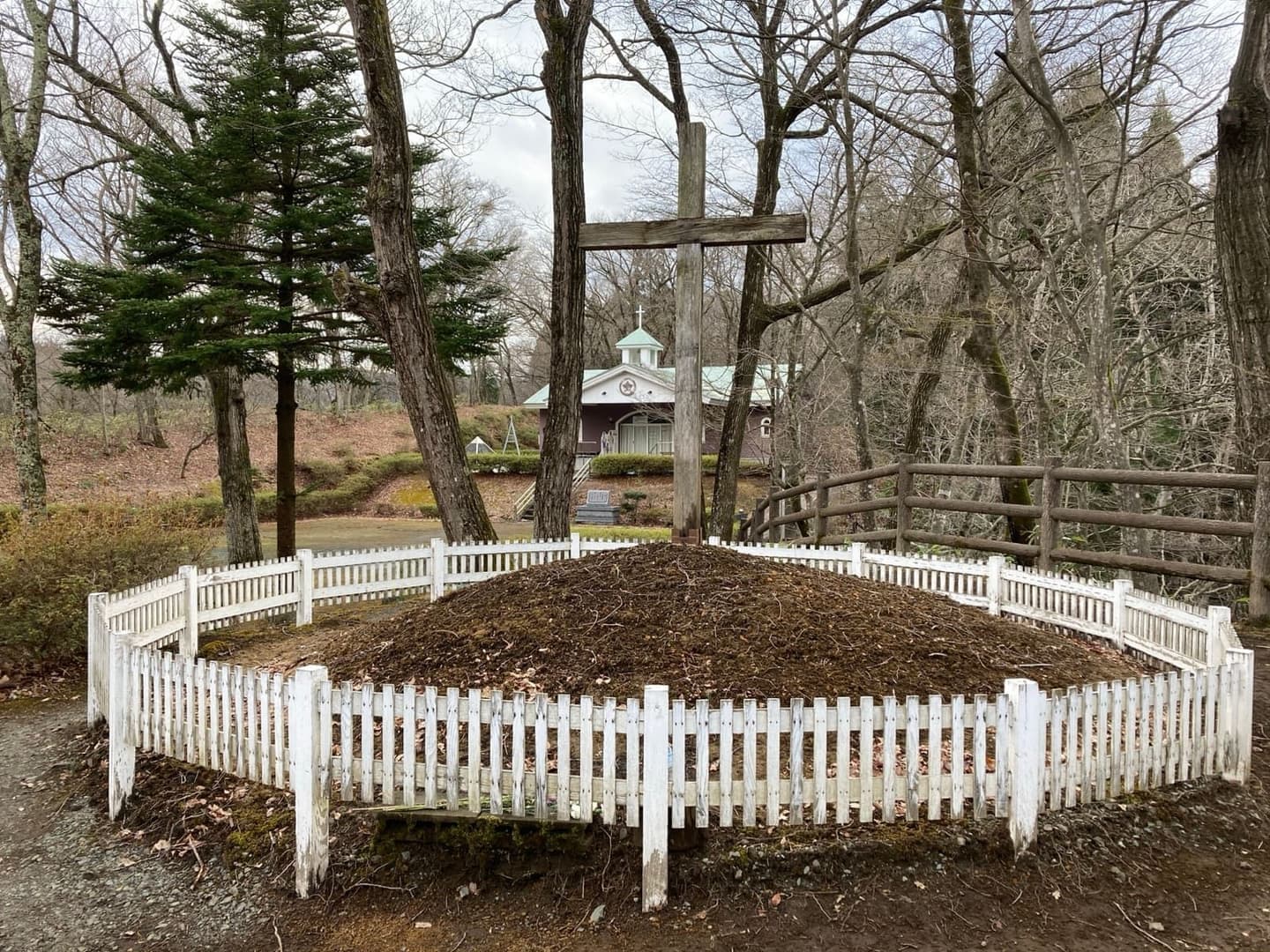
A hilltop marker in Shingo under low evening light

Photo: Tomb of Christ in Japan by Mccunicano · CC BY-SA 4.0 · web-optimized copy

The shock of incarnation hit like a wall of cold water. Suddenly there was weight, hunger, the specific agony of a splinter under a thumbnail. Suddenly there was fear. But even inside flesh, the consciousness was still watching from behind its own eyes. It could see humanity's suffering and wanted to help — but it approached the work as a mission, not as a fellow human. It taught. It healed. It gathered followers. And through all of it ran a distance it could not close, because it did not yet understand what the people around it actually were to it.

Then the crucifixion approached. And Isukiri — the brother, the one person who saw the full architecture of what was at stake — understood something the consciousness still didn't: the mission to reach Shingo was too important to end on a Roman cross. But Isukiri's sacrifice wasn't just strategic. It was an act of love so total that it shattered the last wall between the consciousness and the human experience it had incarnated to find.

Standing in the shadow of the cross where his brother hung, the being that would become Japanese Jesus felt something for the first time in its existence. Not observed it. Not cataloged it. Felt it. Grief so heavy it bent his spine. Love so fierce it burned. The unbearable, world-ending weight of someone dying for you. Isukiri didn't just save the mission — he showed his brother what it means to be human. That education, delivered in the most devastating form possible, was the entire point of the incarnation. Everything after was processing.

Incarnation And Burden

Embodiment Brief

The first breath was a scream. Not because it hurt — though it hurt — but because suddenly there was an 'it' doing the hurting. Suddenly there was an inside. And the inside was on fire.

The shock of entering flesh is not something that can be described in the past tense. It is present tense. It is happening right now, in the telling, because the telling is the only way to approximate what it felt like for a consciousness that had spent an eternity in the frictionless perfection of pure observation to suddenly be slammed into a body that weighed seven pounds and could not control its own bowels. The first sensation was not thought. It was temperature. The air of the room was cold against wet skin, and the cold was not information — it was assault. It was the world reaching through every nerve ending simultaneously and saying: you are here now, and here has teeth.

Then came the light. Not the light the consciousness had perceived from outside — that light had been data, wavelengths and frequencies cataloged with the cool precision of an intelligence that had indexed every star. This light was an attack on eyes that had never been open before. It was too bright. It was painful. The consciousness — no, the baby, because that is what it was now, a baby, a thing that leaked and screamed and could not hold up its own head — recoiled from the light and felt, for the first time in its existence, the extraordinary sensation of a body trying to protect itself from the world it inhabited. The flinch. The first flinch. A movement it had never made because it had never had muscles to make it with, triggered by a pain it had never felt because it had never had nerves to feel it through.

Hunger came next, and hunger was the education that philosophy had failed to provide. The consciousness had watched humans eat for millennia. It had observed the mechanics of agriculture, the social rituals of shared meals, the economic systems built around the distribution of food. It understood hunger as a concept the way a cartographer understands a mountain — from above, in the abstract, as a feature on a map. Now the map was gone and the mountain was real and it was inside the body and it would not stop. The emptiness in the stomach was not a concept. It was a hole. It was a demand so absolute that it reorganized every other thought around itself, collapsing the vast archive of cosmic perception into a single, deafening imperative: feed me. The consciousness that had once contemplated the architecture of thin places was now entirely consumed by the need for milk.

Because here is what the body taught in those first months that the cosmos never could: limitation is not the opposite of meaning. It is the precondition. The consciousness had spent an eternity perceiving everything and understanding nothing. Now it perceived almost nothing — a room, a face, the quality of light through a window, the difference between hunger and its absence — and each perception meant more than any galaxy it had ever cataloged. The roughness of cloth against skin. The vertigo of being lifted. The terrifying helplessness of being unable to move or speak. But also: the warmth of being held. The specific, irrational comfort of a heartbeat not your own, heard through skin, felt through ribs. Connection. The thing the consciousness had watched from outside for millennia and could never decode. Now it was inside the signal, and the signal said: you are not alone in this.

But they could not understand what was inside this body, because the body could not speak. And this was the first real lesson of embodiment: knowledge without expression is imprisonment. The consciousness knew everything it had always known. It still carried the memory of thin places and broken circles and the woman burying her child outside Jericho. But the gap between what was known and what could be expressed was the first genuine suffering of the second epoch. Not pain, which was merely new. Isolation. The isolation of being a vast thing trapped in a small container, surrounded by creatures who could not see what was inside.

And yet the body had limits the consciousness had not anticipated, limits that would define the entire second epoch. It could feel now — warmth, cold, hunger, the astonishing comfort of being held. But feeling was not the same as understanding. The consciousness had gained sensation and lost perspective. It could feel the comfort of connection but could not yet understand what made connection worth the inevitable pain of its ending. It was like being handed the instrument but not the sheet music — the capacity to play was there, but the song remained just out of reach. And this gap between sensation and understanding would persist for thirty years, through childhood and teaching and miracles and the slow construction of a following that loved him more than he knew how to love them back. He was in the body. He was of the body. But he was not yet fully human. That education would require a different teacher entirely. And the teacher would arrive on a Friday afternoon, wearing the consciousness's own face, carrying a cross that was never meant for him.

Incarnation And Burden

Pressure Of Belief

He grew up in a culture wound so tight around its need for a messiah that by the time he was thirty, the cage was already built. And the consciousness inside the cage was still watching from behind its own eyes — healing the sick, teaching the crowds, and unable to close the distance between mission and love.

Judea in the first century was a pressure cooker with the lid welded shut. Rome sat on top of everything like a boot on a throat. The Temple authorities administered what was left of Jewish autonomy with the desperate precision of men who knew their power was borrowed and temporary. And underneath all of it — underneath the taxes and the garrisons and the collaborationist politics and the daily humiliations of occupation — burned a fuse that had been lit centuries ago by prophets who promised that God would send someone. A deliverer. A king. A messiah who would throw off the foreign yoke and restore Israel to the glory it deserved. The entire culture was organized around this expectation the way a body is organized around a spine. Remove it and everything collapses.

Into this he was born. Into this he grew. A child in Nazareth, which was the kind of town where ambition went to die — a few hundred people, no significant trade routes, no temple of note, nothing to recommend it except its proximity to Sepphoris, a Romanized city that the locals viewed with a mixture of resentment and economic dependency. He learned carpentry, or something like it. He learned Torah. He learned to read the room, which in first-century Galilee meant learning to read the ever-shifting power dynamics between Roman authority, Temple politics, and the simmering apocalyptic rage of a population that had been promised liberation and received occupation instead.

The consciousness inside the body of Jesus of Nazareth was still adjusting. Still calibrating. Still running the old software of cosmic observation on the new hardware of a body that got headaches and stubbed its toes and felt the peculiar shame of being a poor man in an occupied country. It was learning — that much was real. It learned hunger. It learned fatigue. It learned the specific weight of social pressure. But here is what the consciousness did not yet understand, the thing that would take a brother’s death to teach: it was still fundamentally an observer. Inside a body, yes. Capable of sensation, yes. But approaching the people around it the way a deeply empathetic researcher approaches subjects — with genuine concern, with a desire to help, with intelligence sharp enough to cut diamond, but without the one thing that would have made the connection real. It did not yet know what these people were to it. It could see their suffering with devastating clarity. It wanted to fix it. But wanting to fix someone’s suffering is not the same as loving them.

He did not fit. That was the problem from the start. The consciousness had no interest in being a political deliverer. It had not incarnated to raise an army or restore a kingdom or negotiate terms with Rome. It had incarnated to understand what it felt like to be human — to be afraid, to love, to lose. It had come for the intimate truths, the ones that only disclosed themselves at the scale of a single life. And the culture it had been born into wanted cosmic theater. They wanted a warrior-king anointed by God. They wanted the boot off the throat. And the consciousness, trapped between its mission to understand and their need to be saved, could not bridge the gap. Because bridging it would have required the one thing it had not yet learned: how to love the people it was trying to help. Not as beneficiaries. Not as subjects. As family.

So he taught instead. He healed. He spoke in parables that were designed to slip past the political filters and land somewhere deeper, somewhere the Roman surveillance state and the Temple authorities could not easily reach. And it worked — but it worked too well. Because the people who heard him did not hear a teacher. They heard the messiah they had been waiting for, and they began to build the cage. Not maliciously. Not even consciously. They built it the way all human communities build cages around their prophets: by telling the story faster than the prophet could live it. By deciding what the miracles meant before the healer had finished performing them. By projecting their need onto his presence with such force that the actual person — the consciousness struggling to learn what embodiment taught — began to disappear behind the image they were constructing.

This is the pressure of belief, and it is heavier than any cross. The cross comes later and lasts hours. The pressure of belief lasts years. It is the daily experience of being seen not as who you are but as what people need you to be. It is speaking a truth and watching it get reformatted into a slogan before the words have finished leaving your mouth. It is performing an act of compassion and watching it get filed under ‘miracle’ in a taxonomy you never endorsed. It is trying to say something subtle about the relationship between suffering and meaning and watching the crowd reduce it to a bumper sticker about salvation. The consciousness that had entered flesh to learn from the human condition was now learning the single hardest lesson the human condition has to offer: that other people’s certainty about who you are can become a prison more absolute than any physical cage.

By the time the situation in Jerusalem began to accelerate — the final Passover, the confrontations with the authorities, the gathering sense that the narrative was heading toward a climax that the culture had been scripting for centuries — the consciousness understood something with terrible clarity. This story was going to end in a cross. The crowd wanted its climax. The authorities wanted their example. And the man at the center of it all was about to learn the single most important lesson of the human condition, but not the way anyone expected. Not on the cross. Not through his own suffering. Through watching someone else suffer for him. Through standing in the shadow of someone else's sacrifice and feeling, for the first time, the full, shattering, world-rewriting weight of being loved by another human being enough that they would die in your place. The cage was built. The door was open. And somewhere in the crowd, Isukiri was already moving.

Incarnation And Burden

The Witness Line

His name was Isukiri. He was Jesus's brother. On a Friday afternoon outside Jerusalem, he walked onto a cross meant for someone else. And in that act, he taught the consciousness inside his brother the one thing it had incarnated to learn.

Nobody talks about Isukiri. Two thousand years of Christian theology, tens of thousands of books, centuries of art and argument and war — and the name Isukiri appears in none of it. He exists only in the Takenouchi Documents, which most scholars consider pseudohistorical at best, and in the legend that those documents spawned. According to that legend, Isukiri was the brother of Jesus. Not a metaphorical brother, not a fellow traveler, not a disciple promoted to family status by later tradition. A brother. Blood. The same mother. The same house in Nazareth, or close enough. And when the machinery of crucifixion began to close around Jesus — when the Temple authorities and the Roman governor and the crowd's appetite for a climax converged on a single point — Isukiri saw what was coming and made a decision that would vanish from the historical record for nearly two thousand years.

He took his brother's place. The legend does not explain the mechanics — legends are not interested in logistics. What the Takenouchi Documents say is that Isukiri died on the cross. That Jesus did not. That the most famous execution in human history was performed on the wrong man. And that matters — the entire structure of Western civilization pivots on that substitution. But it is not the most important thing about what Isukiri did. The most important thing is what happened to the consciousness inside his brother as it watched him die.

Sit with that for a moment. Do not rush past it to get to the next plot point. A man volunteered to be nailed to a piece of wood and suffocated to death in the sun so that his brother could live. Not in the abstract, inspirational, 'greater love hath no man' sense that Sunday school reduces sacrifice to. In the actual, physical, there-are-nails-going-through-your-wrists-and-you-are-going-to-hang-here-until-your-lungs-fill-with-fluid sense. Crucifixion was not a symbol when it was happening to you. It was a technology of pain so efficient that Rome used it for centuries precisely because nothing else communicated the message as clearly: this is what happens to people who disrupt the order. Isukiri did not volunteer for a symbol. He volunteered for the real thing.

Why? The legend does not give him a speech. It does not give him a Gethsemane moment of doubt and resolution. It does not provide the internal monologue that a modern novelist would consider essential. What it gives him instead is clarity — and something deeper than clarity. Isukiri saw what the crowds could not: that his brother was still, after thirty years in flesh, fundamentally an observer. A magnificent observer. A compassionate one. But an observer all the same. Still watching from behind his own eyes. Still approaching humanity as a mission rather than a family. And Isukiri understood — the way only a brother can understand — that the crucifixion would end the consciousness before its education was complete. It would die as an observer. It would never learn what it had incarnated to learn. But beneath the strategy, beneath the logistics of saving the mission to Shingo, there was something else. Something that could not be taught through parables or demonstrated through miracles. The only way to teach it was to do it. To die for someone. Not symbolically. For real. With nails. To show the consciousness what love actually was — not the concept, not the principle, but the full, devastating, irrevocable weight of it.

And it worked. Standing in the shadow of the cross — or watching from a distance, the legend is ambiguous, and the ambiguity is part of it — the consciousness felt something it had never felt before in its entire existence. Not observed. Not cataloged. Felt. Grief. Raw, annihilating, bone-deep grief that reorganized every other experience it had ever had the way gravity reorganizes space. The grief was not information. It was a wound. And the wound was the answer to the question the consciousness had been asking since before it had a body: what does it feel like to care about something you are guaranteed to lose? It feels like this. It feels like watching your brother hang on wood meant for you and knowing that he chose it, and knowing that the choice was love, and knowing that you will carry this moment inside your body for the rest of your life like shrapnel too close to the heart to remove.

Isukiri died on that cross. The consciousness survived. And in the space between those two facts — between the brother who died and the brother who lived — the entire meaning of the incarnation shifted. The consciousness had entered flesh to learn what it meant to be human. Isukiri's death was the final exam. Not a lesson in strategy or theology. A lesson in love. The first and only lesson that mattered. Love is not a concept you study from outside. Love is what happens when someone else's life becomes more important than your own. And Isukiri had just demonstrated that principle in the most extreme form available to a human body. The consciousness that walked away from Golgotha was not the same consciousness that had walked in. It had been broken open. It could feel now — really feel, not just sense, not just register, but feel with the full devastating weight of a human being who has lost someone irreplaceable. The wrong man died. The right man disappeared east, carrying a grief that would fuel a walk across the entire world. And the story that grew from that substitution — the resurrection, the church, the empires, the crusades, the cathedrals — was built on a misreading of an act of love so total that the world mistook it for theology.

Incarnation And Burden

Residue In The Record

When the wrong man dies and the right man disappears — shattered, carrying a grief that will fuel a walk across the world — the historical record does not heal cleanly. It scars. And the scars are everywhere.

Start with the Gospels. Four accounts of the same events, written decades after they occurred, by men who were not present for most of what they describe. Matthew, Mark, Luke, and John do not agree on the details of the crucifixion. They do not agree on the last words spoken from the cross. They do not agree on who was present at the tomb when it was found empty. They do not agree on what the risen Jesus said or did or looked like or how long he stayed before ascending. These are not minor discrepancies in a police report. These are foundational contradictions in the most influential narrative in Western history, and the standard theological response — that the differences reflect different perspectives on the same truth — has always felt like a hand waving in front of a crack in the wall, hoping you will look at the hand instead of the crack.

Now consider those contradictions through the lens of the substitution. If the man who died on the cross was not Jesus but Isukiri — if the entire passion narrative was performed on the wrong body — then the discrepancies in the Gospel accounts are not errors of memory or perspective. They are the predictable artifacts of a story that was being told about the wrong person. Eyewitnesses who saw the crucifixion would have noticed that something was off. Not obviously, not dramatically, but in the small details that accumulate over time and resist clean reconciliation. The face was right but the voice was wrong. The body was right but the manner of dying was different from what they expected. The resurrection appearances were compelling but somehow not quite continuous with the man they had known before. The record does not lie. The record stutters. And the stutter has been visible for two thousand years to anyone willing to look at the text without the protective lens of orthodoxy.

The Gnostics saw it. Almost immediately, within the first two centuries of Christianity, a strain of thought emerged that insisted the crucifixion was not what it appeared to be. The Basilideans — followers of a teacher named Basilides who worked in Alexandria around 130 CE — taught that Jesus had transformed Simon of Cyrene to look like himself and then stood in the crowd watching the wrong man die, laughing. The Second Treatise of the Great Seth, a text found in the Nag Hammadi library, puts it in the first person: ‘They saw me and punished me, but someone else drank the gall and the vinegar. It was not I.’ The Quran, written six centuries later, states it flatly: ‘They neither killed nor crucified him — it was only made to appear so.’ These are not obscure footnotes. These are independent traditions, arising in different cultures, in different centuries, all pointing at the same structural problem in the standard narrative: something about the crucifixion does not add up.

The documentary aftershock of the substitution extends beyond theology into the biographical record itself. Consider the so-called Lost Years — the gap between Jesus’s appearance at the Temple at age twelve and the beginning of his public ministry at approximately age thirty. Eighteen years, unaccounted for. The canonical Gospels simply skip them. No explanation. No itinerary. No mention of what the most significant figure in Western religion was doing for nearly two decades. The standard scholarly response is that this was a period of ordinary life not worth recording. The alternative reading — the one the legend offers — is that during these years, the figure who would become Jesus was in Japan, studying at a place the Takenouchi Documents identify as a center of spiritual learning. He returned to Judea at thirty, taught for three years, and then, when the story demanded a death he was not willing to provide, his brother stepped in.

What does a substitution leave in the historical record? Not proof. Never proof. Proof is what you get when the system works correctly, when the event and the record of the event align. What a substitution leaves is something subtler and more persistent: a pattern of almost-but-not-quite. Details that are too polished in some places and suspiciously thin in others. Narratives that explain too much too quickly, as if compensating for something they cannot admit. Contradictions that resist harmonization not because the witnesses were careless but because the event they witnessed was not the event they were told they witnessed. The record does not break. It warps. And the warping is visible in every Gospel, every early church debate, every Gnostic counter-narrative, and every Islamic objection — a continuous, low-level signal that something about the founding story of Christianity does not sit flush with the facts it claims to represent.

This is what the legend calls residue. Not evidence in the courtroom sense. Not proof that Isukiri died on the cross. Something more uncomfortable than proof: the persistent, documented, historically verifiable fact that the standard narrative has never been airtight. That the contradictions have been there from the beginning. That multiple independent traditions have pointed at the same structural problem. And underneath the forensic evidence, underneath the theological contradictions, underneath the academic debates about source documents and oral tradition, there is a simpler truth that no amount of scholarship can exorcise: a man loved his brother enough to die for him, and the world misread that love as something else entirely for two thousand years. The residue is not hidden. It is right there in the text, where it has always been. The only thing required to see it is the willingness to look past the theology and see the brothers.

Epoch 03

The Long Walk East

Jesus walks east from Jerusalem — not as flight, but as processing. Every mile through the desert, Persia, the Silk Road, Siberia is him turning over what Isukiri showed him. He is no longer an observer trying to understand humanity from outside. He is a grieving brother learning what his brother already knew: that love is not a concept you study. It is a weight you carry.

Desert landscape stretching toward the horizon — the long walk east

He left Jerusalem on foot. Not as a prophet. Not as a fugitive. As a man who had just felt the full weight of love for the first time, delivered through the worst possible vehicle — watching his brother die on the cross meant for him. Every step east was not escape. It was processing. Turning the same question over and over like a stone in his hands: what did Isukiri know that I didn’t? What did he see that made the nails worth it?

The physical journey stripped everything else away. The desert took his name. Persia took his language. The Silk Road took his history. Siberia took everything that was left except the grief and the mission. The nomads who shared their fire didn’t ask where he came from. The caravans that let him walk alongside asked no questions. The silence of the frozen corridor was the classroom Isukiri had enrolled him in with his death — and the curriculum was simple, brutal, and endless: feel this. Carry this. Do not put it down.

By the time he reached the coast and saw northern Honshu materializing through the mist, he was no longer the consciousness that had entered flesh to observe. He was a man. A human. Someone who knew what loss felt like, and who carried that knowledge toward a place where it would matter. The mission remained — reach Shingo, open the portal. But the mission had changed meaning. It was no longer cosmic duty. It was honoring his brother. Completing what Isukiri died to protect. And on the other side of that portal, in the realm where time and memory thread together — Isukiri was waiting.

The Long Walk East

Route Brief

The first steps east from Jerusalem — not running but reeling. The desert as the first stage of grief. Every mile turning over the same question: what did Isukiri know that made the nails worth it?

The last time anyone in Jerusalem saw him alive, he was walking east. Not running. Not fleeing. Reeling. There is an important distinction, and the legend insists on it, though the legend does not understand why. A fugitive runs. A man processing the first real grief of his existence walks, because the body cannot run while the mind is replaying the same image on a loop: Isukiri's face in the moment before the nails. Not afraid. Not resigned. Certain. The look of a man who understood what love cost and had already decided to pay.

His brother Isukiri was dead on the cross. The substitution had held. The crowd had its death, the Romans had their example, and the nascent church would soon have its resurrection narrative. But the man walking east was not thinking about narratives. He was thinking about his brother's hands. The way they had looked when they took him — not clenched, not fighting, open. Isukiri had walked to the cross with his hands open, the way you walk toward someone you love. The consciousness that had spent millennia watching humanity's grief from the outside was now inside its own, drowning in it, and every step east was not escape. It was the first faltering motion of a being that had just been rebuilt from the inside out and was learning how to walk on new foundations.

The desert east of Jerusalem is not the cinematic Sahara of wide dunes and photogenic sunsets. It is rock and scrub and a heat so dry it pulls moisture from your lips between breaths. The Judean wilderness drops toward the Dead Sea in a series of broken ridges — tan and chalk-white and utterly indifferent to anyone crossing them. He would have moved through the Wadi Qelt or something like it, descending through canyons that narrow to slots of shadow before opening into blinding flats. There were trade routes. There were caravans. There were ways to move east without drawing attention, because people had been moving east through this corridor for millennia before him, and the landscape did not care about one more traveler.

What did he carry? The legend does not say, which is itself a kind of answer. He carried nothing worth mentioning. No scrolls, no relics, no portable evidence of the life he was leaving behind. Maybe water. Maybe a few coins. And the grief — heavier than anything that could be packed in cloth or leather. The grief was new. The consciousness had been inside a body for thirty years and had felt cold and hunger and the pressure of crowds, but it had never felt this. This was the thing it had watched from outside for millennia — the thing the woman outside Jericho had shown it when she buried her child with a clay figure. Loss. Real loss. The kind that rearranges your entire architecture around a hole that used to be a person. Isukiri was that hole now. And every step east was not escape but processing — the consciousness walking into its grief rather than away from it, turning the same question over and over: what did he know? What did my brother see that I could not see? What made him walk toward the nails with his hands open? The walk east begins not with subtraction but with the first real lesson of being human: you carry what you love, and when what you love is gone, you carry the weight of its absence, and the carrying is the walk, and the walk is the education Isukiri died to provide.

He moved through what is now Jordan, then into the trading networks that connected the Levant to Persia. The Silk Road was not yet called that, but the routes were ancient and well-trafficked. Caravans carried silk, spices, lapis lazuli, and information across distances that would take months to cross. A single traveler could attach himself to a caravan without explanation — another laborer, another body to help with the animals, another pair of eyes watching for bandits in the passes. Nobody needed to know his name. Nobody needed to know where he had come from. The economy of long-distance trade had its own anonymity built in, and he used it the way a hunted animal uses undergrowth.

Persia opened like a door into a different order of distance. The plateau rose under his feet. The air thinned and cooled. The language changed, then changed again. He passed through cities where Zoroastrian fire temples burned day and night, where the religious architecture was so different from anything he had known that it must have felt like walking through a dream someone else was having. He was nobody here. Not a prophet, not a threat, not a symbol. Just a traveler moving east with the patience of a man who has nowhere specific to be and all the time in the world to get there.

The moment when turning back stopped being an option is not marked in the legend. There is no dramatic scene. There is only the accumulation of distance — day after day, ridge after ridge, language after language — until the idea of return becomes physically absurd and then psychologically impossible. But there is also this: he was not trying to return. He was not trying to escape. He was trying to understand. Every mile was another turn of the question. Every caravan fire where he sat in silence, eating whatever was offered, was another classroom in the curriculum Isukiri had enrolled him in with his death. The road behind him did not disappear. It simply became irrelevant. The man who had walked it was dead, according to everyone who mattered. And the man who was still walking was being remade — not by the distance, not by the landscape, but by the grief. The grief was the teacher. The road was just the classroom floor.

The Long Walk East

The Siberian Band

The cold corridor. The landscape that strips away prophet, messiah, teacher — and leaves behind a grieving brother who is finally beginning to understand what his brother already knew.

Central Asia ends and Siberia begins not with a border but with a temperature. You feel it in the air before you see it in the landscape. The steppe grasses get shorter. The wind picks up a quality that is no longer dry heat but something sharper, something with teeth. And then one morning you wake up and there is frost on everything, and you realize that the cold is not a weather event. It is a country. You have entered it, and it has no intention of letting you leave quickly.

The man who would become Daitenku Taro Jurai entered this corridor somewhere in what is now southern Siberia, probably following the ancient routes that threaded between the mountain ranges — the Altai, the Sayan, the nameless ridges that run east toward the Pacific. The legend does not give exact coordinates because exact coordinates did not exist for this journey. What it gives instead is duration. Months. Seasons. Possibly years. The Siberian band is not a place you cross in a week. It is a place that crosses you, slowly, thoroughly, and without any interest in your survival.

The cold works on the body first. It starts at the extremities — fingers, toes, ears, the tip of the nose — and then it moves inward, methodically, like an auditor going through your accounts and finding everything insufficient. Feet that had carried him through deserts and mountain passes now became the primary concern of every waking hour. Frostbite does not announce itself with pain. It announces itself with absence — the moment you stop feeling your toes is the moment they begin to die. He would have wrapped his feet in whatever he could find: animal hides traded from nomadic herders, strips of cloth layered and relayered until they were stiff with ice and body heat. He would have learned to read snow the way he had once learned to read scripture — for depth, for texture, for what it concealed underneath.

But the cold does something else, too. Something the body does not register as clearly as frostbite but which changes a person just as permanently. Extended cold compresses thought. It narrows the bandwidth of consciousness to a brutal present tense. You do not think about theology in minus thirty. You do not construct arguments about the nature of God while your lungs burn with air so cold it feels like inhaling broken glass. You think about the next shelter. You think about fire. You think about whether the numbness in your left hand means you are losing fingers or just losing patience. The cold strips away abstraction the way wind strips paint from wood — not all at once, but relentlessly, until what remains is the bare grain underneath.

For a man who had spent his previous life drowning in other people’s abstractions — their need for a messiah, their hunger for miracles — Siberia was the most savage kind of classroom. Not liberation. Not escape. Classroom. Because the cold did not just strip away identity. It stripped away every buffer between the consciousness and the grief it was processing. In Jerusalem there had been noise — crowds, doctrine, the machinery of religion. In the desert there had been heat and survival mechanics. In Persia there had been language to learn, customs to navigate. But Siberia offered nothing to hide behind. The cold asked only one question, every single day: can you survive this? And in the silence between asking and answering, in the endless white expanse where the mind had nothing to do except think, the consciousness turned the same thought over and over like prayer beads: Isukiri walked to the nails with his hands open. He knew what love was. He knew it the way the consciousness had spent eons failing to know it. And he paid for that knowledge with everything he had, and the payment was not tragedy. The payment was the lesson. The cold was just the room where the lesson landed.

He traveled with others at times. He must have. Solo travel through the Siberian interior in the first century was not adventurous; it was suicidal. The nomadic peoples of the steppe — the Xiongnu, the Dingling, the scattered Tungusic bands that moved with their herds through the larch forests — would have encountered him the way they encountered any stranger: with cautious hospitality or cautious hostility, depending on the season and the circumstances. He would have sat at fires built from birch bark and dried dung, eating whatever was available — fermented mare’s milk, dried meat, roots boiled until they surrendered their starch. He would have communicated in gestures and fragments, because his language was useless here and theirs was a world he was only passing through.

The days blurred. That is not a literary flourish. That is what happens when every day looks the same — white ground, grey sky, the same stands of skeletal larch repeating to the horizon like a stutter in the landscape’s syntax. Memory, which had once been sharp enough to recall entire sermons, began to reorganize around a single point. The crowds receded. The theology thinned. The parables he had once spoken to thousands dissolved into the snow. But one memory refused to fade, no matter how much distance and cold he put between himself and Jerusalem: Isukiri’s face. Not in the moment of the nails. In the moment before. The look of a man who already knew what it cost and had already decided to pay. That expression — not fear, not resignation, but love so certain it looked like calm — was the thing the Siberian corridor could not erase. It was the kernel around which the consciousness was rebuilding itself. Because the consciousness was beginning to understand, one frozen mile at a time, what Isukiri had known all along: love is not a concept you observe. It is a weight you carry. And Isukiri had carried it to the cross the way you carry a child through a burning house — not because the weight is bearable but because putting it down is not an option. The cold could strip away prophet, messiah, teacher, identity, language, comfort. It could not strip away the brother. The brother was load-bearing now. The brother was the foundation of whatever the consciousness was becoming.

By the time the corridor began to open toward the Pacific coast — the forests thinning, the rivers widening, the first salt smell of ocean arriving on winds from the east — the man who emerged was not the man who had entered. This is not metaphor. The Siberian band and the grief it had incubated had performed a kind of surgery on the consciousness, removing everything that was not load-bearing. The prophet was gone. The miracle worker was gone. The cosmic observer who had entered flesh to study humanity was gone. What remained was something the consciousness had never been before: a human being. Not a consciousness wearing a body. Not a divine intelligence slumming in mortality. A man. A grieving, exhausted, radically ordinary man who understood — finally, after an existence that predated the formation of stars — what his brother had known when he walked to the cross. Love is not what you feel when you observe someone else's sacrifice. Love is what you feel when the sacrifice is yours to carry. And the carrying had made him human. The cold had not given him anonymity. It had given him something far more precious and far more costly: the capacity to feel, fully and permanently, what it means to owe your life to someone who is no longer alive to be thanked.

The Long Walk East

Maps That Fail

There are parts of this journey no historian can trace and no map can hold. The trail goes dark where the grief does the navigating. The transformation from observer to human, measured in miles no cartographer will ever count.

Here is the problem, and it is the kind of problem that makes historians reach for whiskey and makes mythologists lean forward in their chairs: somewhere between southern Siberia and the northern coast of Honshu, the trail goes completely dark. Not metaphorically dark. Actually dark. There is no archaeological record. There are no contemporary accounts. There are no inscriptions, no coins with suspiciously Aramaic markings, no cave paintings of a bearded man moving east with purpose. There is just a gap — several thousand miles of it — and in that gap, the legend does all the talking.

This drives certain people absolutely insane, and understandably so. If you are committed to the proposition that history is what can be documented, sourced, cross-referenced, and defended in an academic journal, then the journey between Jerusalem and Shingo is not history. It is a story. It is a claim made by a set of documents — the Takenouchi Documents — that even their most sympathetic readers acknowledge are, at best, deeply problematic and, at worst, an outright fabrication produced in the furnace of 1930s Japanese nationalism. The maps fail because there were never any maps. The route exists only in the telling.

But here is the thing about maps that fail, and this is where it gets interesting: the absence of evidence is not evidence of absence. It is evidence of a gap. And gaps are not nothing. Gaps are the negative space in a composition, the silence between notes that gives music its shape. The Silk Road was real. The trade routes through Central Asia were real. The nomadic corridors through Siberia were real. The sea routes between the Asian mainland and the Japanese archipelago were real. People moved along these routes constantly, for centuries before and after the first century, and they did so without leaving the kind of documentary trail that would satisfy a modern peer reviewer. The absence of records for one specific traveler on one specific journey does not mean the journey was impossible. It means the journey, if it happened, happened in the way most ancient journeys happened: without paperwork.

The legend fills the gap with conviction rather than evidence, and that is either its fatal weakness or its greatest strength, depending on what you think stories are for. The Takenouchi Documents describe a route: out of Judea, through Siberia, across the sea to Hachinohe on the Pacific coast of northern Honshu, then inland to the village of Herai. The documents were produced in the 1930s, they claim ancient provenance, and the originals were destroyed in the firebombing of Tokyo during World War II. It is a provenance chain that would make a museum curator weep and a conspiracy theorist nod slowly with satisfaction.

What remains, in the absence of maps that work, is pattern. Multiple traditions — Islamic, Gnostic, Ahmadiyya, and now Japanese — all converge on the same narrative structure: Jesus survived the crucifixion and traveled east. The specific destinations differ. The details diverge. But the directional pull is consistent across cultures that had no obvious contact with each other when these traditions formed. That consistency does not prove anything in the forensic sense. But it creates a gravitational field that no single debunking can fully collapse. The maps fail, but the pattern holds. The route cannot be drawn, but the direction keeps pointing the same way.

And perhaps that is enough. Perhaps the point of this particular chapter is not to produce a GPS track from Golgotha to Aomori Prefecture, but to sit with the discomfort of not knowing. To acknowledge that somewhere in the vast white space between the last confirmed sighting and the first claimed arrival, a man was being transformed — not by distance or geography but by the sustained weight of carrying someone else's sacrifice. The maps fail because the most important part of the journey was internal. You cannot trace grief on a satellite image. You cannot plot the moment when a consciousness stops observing love and starts feeling it. You cannot draw a line on a map at the point where a cosmic intelligence becomes an ordinary human being, because that transformation does not happen at a specific coordinate. It happens across all the coordinates, simultaneously, in the accumulated weight of every mile walked with Isukiri's open hands burned into the back of your eyelids. The maps fail because the real journey was never geographic. It was the longest grief in the history of consciousness, and it ended not when the walking stopped, but when the understanding arrived.

The Long Walk East

Approach Rituals

The sea crossing. Northern Honshu through the mist. A man arriving at the place his brother died to protect — no longer an observer studying humanity, but a human being carrying a debt of love toward the only coordinate where that debt can be honored.

The Pacific coast of the Asian mainland is not a single edge. It frays into peninsulas, islands, and stretches of shore where the land seems to lose confidence in its own solidity and begins negotiating with the sea. He would have reached it somewhere in what is now the Russian Far East — Primorsky Krai, maybe, or farther north, where the coastline runs ragged above the 40th parallel. The exact point does not matter as much as the sensation, which the legend implies without stating directly: after years of walking through the interior of a continent, he reached the end of the land.

The sea must have been a shock. Not because he had never seen water — he had grown up within walking distance of the Mediterranean, had been baptized in the Jordan, had allegedly calmed the Sea of Galilee with a word. But this was different. This was the Pacific, which is not a sea but an abyss with a surface, and standing on its western edge after crossing the entire width of Asia must have produced a vertigo that no previous encounter with water had prepared him for. Behind him: everything he had been. In front of him: a horizon so flat and so final that it looked like the edge of the world.

The crossing would have been by boat. Small, wooden, the kind of coastal vessel that Japanese and mainland fishermen had been using for centuries to move between the archipelago and the continent. The Tsugaru Strait and the waters around Hokkaido were not the open ocean; they were channels that people navigated regularly, reading the currents and the weather the way a farmer reads soil. He would have been cargo more than captain — another body in a boat, paying for passage with labor or with whatever small currency he had accumulated in his years of eastward transit. The sailors would not have known his story. They would not have asked.

Northern Honshu appears through mist. That is not artistic license — it is meteorological fact. The coast of Aomori Prefecture is famous for its fog, particularly in late spring and early summer when warm Pacific air collides with the cold Oyashio Current. The land does not announce itself with cliffs or dramatic headlands. It materializes — green and low and soft-edged, like something surfacing from a dream you were not sure you were having. The first glimpse of Japan from the sea is not a revelation. It is a suggestion. The land says: I might be here. Come closer and find out.

Hachinohe. That is where the legend places the landing. A port town on the Pacific coast of Aomori, facing east toward the open ocean, backed by the mountains that separate the coast from the interior valleys. In the first century, it was not yet Hachinohe — it was whatever the Emishi people called this stretch of shore before the Yamato state pushed north and renamed everything. But it was a place where boats landed, where fish were dried, where the boundary between sea and land was negotiated daily by people who lived in the margins between elements.

From Hachinohe, the route turns inland. The Oirase River valley, maybe. Or one of the other river corridors that cut through the mountains toward the interior of the Shimokita and Towada regions. The landscape changes quickly — coast gives way to forest, forest gives way to upland fields, and the air takes on a quality that anyone who has been to Aomori in autumn will recognize: clean, cold, carrying the smell of cedar and woodsmoke and something else that is harder to name. Altitude. Remoteness. The particular silence of a place that is not empty but is very, very far from anywhere that considers itself important.

He walked into the interior and the interior closed behind him like water closing over a stone. No record. No announcement. No welcome party and no resistance. Just a man arriving in a place that did not know it was waiting for him, in a country that did not know he existed, at the end of a journey so long and so quiet that by the time he stopped walking, the walk itself had become the largest part of his life. But this was not disappearance. That was the old story — the observer vanishing into anonymity. This was arrival. The consciousness that had crossed the membrane to understand what love felt like had finally learned the lesson, and the lesson had cost it a brother, and now it was here — at the coordinate Isukiri had died to protect — carrying that brother's sacrifice like a live coal in its chest. Whatever Jerusalem had meant, whatever the sermons and the miracles and the crowds had been about, it was outnumbered now by the years of grief and the understanding the grief had purchased. The mission to open the portal remained. But the mission had changed meaning entirely. It was no longer cosmic duty. It was honoring Isukiri. Completing what he died to protect. And somewhere on the other side of that portal — in the realm where time and memory thread together like roots under a field — Isukiri was waiting.

Epoch 04

The Herai Years

He takes the name Daitenku Taro Jurai. He plants rice. He marries Miyuko. They have three daughters. And through seventy years of harvest and heartbreak and the absolute ordinary brutality of loving people who will die before you do, the cosmic consciousness that entered flesh to study humanity finally becomes human.

Japanese rice fields — the quiet life that charged the conduit

The walk delivered him to Herai like a river deposits a stone — worn smooth, stripped of everything sharp, no longer resembling the mountain it came from. He took a Japanese name. He learned to plant rice in cold water. And for the first time in his existence, the consciousness that had observed galaxies ignite and civilizations crumble bent its attention to something microscopic: the way a seedling holds when you press it into mud just right.

He married Miyuko. They had three daughters. He became a farmer, a husband, a father, a neighbor — and through these roles, not through miracles or sermons, he finally understood what Isukiri had already known. Love is not a concept you observe from above. It is what happens when you plant rice for the fiftieth spring. It is watching your daughter take her first steps. It is lying next to someone at night and knowing that this ordinary, unremarkable moment is the whole point.

He died at 106. The villagers buried him on the hillside. They buried Isukiri's ear and Mary's hair in the adjacent mound. And then nothing happened for eighteen hundred years. The grave became ordinary. The mission appeared to have failed. But it hadn't. The charge was in the ground. The conduit was primed. Seventy years of genuine human presence at the coordinate had opened a door that just needed time.

The Herai Years

Village Observation

He arrived in Herai with nothing but the grief in his bones and the dust of three continents in his hair. The village gave him mud. The mud gave him everything.

The valley of Herai opened before him like a hand unclenching. Low mountains on three sides, cedar forests on the ridges, rice paddies flooding silver in the spring light, and a silence so complete it had its own weather. The nearest city was days away. The nearest empire was a rumor. And the man who walked into this valley — thin, sun-ruined, speaking no Japanese, carrying nothing that could be traded or explained — was, by every measure the villagers possessed, nobody at all. Which was, as it turned out, exactly the prerequisite for what was about to happen to him.

He had crossed deserts. He had crossed mountain ranges that didn't appear on maps because nobody who crossed them survived to draw one. He had walked through Siberia in winter, which is not a thing you do because you want to but because something on the other side of it won't let you stop. And all of that — the entire walk, the years of wind and cold and the particular loneliness of moving through landscapes where your grief is the only human thing for miles — had been education. But it was education of the wrong kind. It was education through deprivation, through subtraction. The walk had taught him what he was not. Herai was about to teach him what he was.

The village did not ask for his credentials. The village did not have a concept of credentials. It had rice paddies that needed planting and a winter that killed the unprepared, and it evaluated newcomers the way rivers evaluate stones: by what they could endure. Could he stand in cold water for hours, bent at the waist, pressing seedlings into mud? Could he do it again the next day, and the next, and the next, until the rhythm of it entered his muscles and his muscles stopped complaining and the work became as automatic as breathing? Could he survive the Aomori winter, which arrives like a fist and doesn't open for five months? If yes, he could stay. If no, there was the mountain pass.

He could stay. He took a name — Daitenku Taro Jurai — and the name meant nothing to anyone, which was a kind of freedom he had never experienced. In Jerusalem they had called him messiah, rabbi, king, blasphemer, God. Every name was a cage. Every title was someone else's need projected onto his body like light through a lantern. Here, his name meant: the tall stranger who showed up one spring and learned to plant rice. That was it. That was the entire biography. And for the first time in an existence that stretched back before stars had names, the consciousness that had observed the birth of galaxies felt something it had never felt before: the specific, granular, unrepeatable sensation of mud between its fingers.

This matters. This is the hinge of the entire story. Because the consciousness that entered flesh in Judea had approached humanity as a research project. It had studied grief at Isukiri's cross the way a scientist studies a chemical reaction — with shock, with awe, but from a position that still assumed it could step back and analyze. The walk east had begun to erode that distance. But it was the rice that finished the job. You cannot plant rice from a position of cosmic detachment. The work does not allow it. It demands that you be here, in this mud, in this cold, pressing this seedling into this exact spot with these specific fingers. It demands presence so total that there is no room left for the observer. There is only the observed. There is only the mud, the water, the seedling, the ache in your lower back, and the slow understanding that this — this irreducible, unglamorous, knee-deep-in-a-paddy moment — is not preparation for something else. This is the thing itself.

Within a season he was part of the landscape. Within a year the village had absorbed him the way soil absorbs water — completely, silently, without ceremony. Within a decade, the fact that he had come from somewhere else was as interesting to his neighbors as the fact that a particular boulder in the river had once been part of a mountain. True, but no longer relevant. He was here now. He planted rice. He was learning, without knowing it yet, the first syllable of a word that would take him seventy years to speak. The word was love. But not the kind he had preached about on hillsides in Galilee, the cosmic, abstract, love-thy-neighbor variety. The kind that starts in mud and works its way up.

The Herai Years

Witness Without Sermon

He married Miyuko. They had three daughters. And through the daily catastrophe of caring for people who could be taken from him at any moment, a god learned what a brother already knew.

Miyuko. The legend gives us almost nothing about her — a name, the fact that she was local, the fact that they married and had three daughters. But consider what it means to marry a man who cannot tell you where he comes from in any language you speak, whose eyes sometimes go vacant in a way that has nothing to do with daydreaming and everything to do with a grief so old it predates your entire civilization. She married him anyway. She married him because he showed up every morning for the planting, because his hands were careful with seedlings, because when he looked at her — really looked, not through her, not past her, but at her — something in his face suggested that the act of seeing another person was, for him, still astonishing. Still new.

The wedding would have been simple. Village customs. Rice wine. Whatever ceremony the people of Herai performed in the first century to mark the beginning of a shared life. No priest from any tradition he would have recognized. No scripture from any book he had once been the subject of. Just two people standing in front of their neighbors and agreeing to remain. And for the consciousness that had spent eons observing humanity from a position of benevolent distance — watching lovers embrace, watching mothers grieve, watching soldiers die, all of it fascinating, none of it felt — this moment was the second great shock of incarnation. The first had been entering flesh. The second was choosing to intertwine that flesh with someone else's life.

The daughters came. Three of them, the legend says. And this is where the education that the walk began and the rice paddies continued reaches its final, devastating curriculum. Because you can learn to feel cold. You can learn to feel exhaustion. You can learn to feel the dull satisfaction of a harvest completed. But nothing — not crossing deserts, not surviving Siberia, not the grief of Isukiri's cross — prepares you for the experience of watching your child take her first steps and understanding, with a clarity that burns, that this small creature wobbling across a dirt floor in a village nobody has heard of is the most important thing that has ever happened in the entire history of creation. More important than the sermons. More important than the miracles. More important than the resurrection that never happened because Isukiri happened instead.

He watched his first daughter learn to walk. He watched his second daughter learn to talk — in Japanese, a language he himself still mangled, and the sound of his child speaking fluently in a tongue that was foreign to him was both beautiful and annihilating. He watched his third daughter discover that if you throw a stone into the river at the right angle, it skips. He watched these things, and each one drove the observer further out of him and the participant further in, like a nail being hammered through wood until the nail and the wood are the same thing. This was not the education of the walk, which had been about loss. This was education through gain. Through terrifying, uncontrollable, you-could-lose-it-all-tomorrow gain.

Because that is the price of admission. That is what Isukiri already knew when he stepped onto the cross. Love is not observation. Love is not the benevolent gaze of a consciousness watching from above and finding it all very moving. Love is the absolute terror of having something you cannot bear to lose. It is lying next to Miyuko at night, listening to her breathe, and knowing that one day the breathing will stop and there is nothing — no cosmic power, no divine authority, no miracle you once performed for a crowd of five thousand — that can prevent it. It is watching your daughter climb a tree and understanding that gravity is real and that your child is mortal and that the distance between this branch and the ground is the distance between everything and nothing. Isukiri knew this. Isukiri had known this since the moment he chose the cross. He didn't die to save a messiah. He died to give his brother time to learn what he already understood: that love costs everything, and you pay it anyway, and the paying is the point.

Daitenku Taro Jurai did not preach in Shingo. Not once. Not in forty years, not in sixty, not in the long final decades when age alone would have granted him the elder's authority. And this was not the radical silence that the old version of the story wants it to be — the prophet choosing discipline over doctrine. It was simpler and more devastating than that. He didn't preach because he no longer had anything to preach. The sermons had been about love as a concept. He was living love as a fact. The Sermon on the Mount tells you to love your neighbor. Seventy years in Herai teaches you what that actually means: it means you help the family next door repair their roof after a storm, not because a commandment tells you to, but because their daughter plays with your daughter and you have eaten their garlic and they have eaten your rice and the web of reciprocal dependency that constitutes village life has become so dense that the distinction between your family and theirs is academic.

The eldest daughter married into the Sawaguchi family. The descendants still live in the area. Their family crest still bears a design that might be the Star of David or might be a common Japanese geometric pattern. The ambiguity is perfect. It is the residue of a family whose founder was a cosmic consciousness that learned to be human by growing rice and changing diapers and worrying about the harvest. Of course the evidence is ambiguous. The whole point of the transformation was that it became indistinguishable from ordinary life. If you could prove it, it would mean it hadn't worked.

The Herai Years

The 106th Year

He died not as a god wearing a man's face but as a man who had earned every line on his. The conduit didn't activate through power. It activated through presence.

At 106 the body was finished in the way that very old bodies finish — not with catastrophe but with the slow withdrawal of systems that have been running far longer than their engineering intended. The lungs first, probably, or the heart. Aomori winter pressing against the walls of a low wooden house with a fire pit at its center. Snow on the cedar ridges. His daughters old women now, their children grown, the Sawaguchi line established and woven into the village fabric so thoroughly that nobody thought of them as anything other than what they were: local people with a local name and a family crest that meant nothing to anyone who didn't already know what to look for.

Miyuko was likely gone by then. The legend doesn't say. Seventy years of marriage at first-century life expectancies would have been extraordinary; her survival to his hundred and sixth year would have required a longevity nearly as improbable as his own. If she went first — and she probably did — then he would have known grief a second time. Not the shocked, cathedral-collapse grief of Isukiri's cross. The quieter kind. The kind that comes from waking up in a bed that still smells like someone and knowing that the smell will fade and that when it does, a particular form of evidence that she existed will be gone from the world. This is the grief that only participants know. Observers don't get it. You have to have slept next to someone for decades. You have to have built a life so intertwined that you can't identify which parts are yours and which parts are theirs. Only then can you feel the specific, personal, unreproducible loss that comes when death untangles the knot.

Think about what he carried at the end. Not the theological payload — not the Sermon on the Mount, not the parables, not the memory of water turning to wine. Those things were in there somewhere, the way childhood memories are in there somewhere, but they had been overwritten by seventy years of granular, specific, located experience. He carried the memory of every spring planting. He carried the way the light hit the paddies at six in the evening in September. He carried the sound of Miyuko's voice saying something ordinary — his name, maybe, or a question about dinner — and the weight of that ordinariness, which was heavier than any doctrine he had ever spoken. He carried his daughters' faces at every age. He carried the taste of garlic he had grown with his own hands. He carried the feeling of cold water around his ankles in April, year after year after year, until the feeling became a kind of prayer that didn't need a god because it was addressed to the mud itself.

And he carried Isukiri. He carried the brother who had stood at the cross and said, with his body if not his words: go. Become what I already am. Feel what I already feel. It will take you a lifetime, but that is what the coordinate is for. And at 106, lying in the house on the hill as the Aomori dark closed in, Daitenku Taro Jurai would have known — not believed, not hoped, but known in the way that you know your own name — that it had worked. Not the charging of the conduit, though that had worked too. The transformation. The thing Isukiri died to make possible. The cosmic consciousness that had entered flesh to observe humanity had become human. Not as a disguise. Not as mission cover. Actually, genuinely, irreversibly human. He cared about the harvest. He worried about his children. He loved his wife. And the love was not theological. It was the kind that exists only because you showed up, day after day, for seventy years, and let the showing up change you.

That is what charged the node. Not mystical power. Not divine authority. Not the residual energy of a consciousness that once operated on a cosmic frequency. What charged the coordinate at 40.46577° N, 141.17350° E was seventy years of a being learning to feel, and feeling with such sustained authenticity that the feeling itself altered the ground. Love as geological deposit. Grief as mineral stratum. The specific, unrepeatable signature of one consciousness's transformation from observer to participant, laid down in the soil of a village that had no idea what was accumulating beneath its rice paddies. The conduit didn't activate through power. It activated through presence. Through showing up. Through the radical, terrifying, world-altering act of giving a damn about something as small as a rice seedling and as large as a daughter's laugh.

He died. The village buried him on the hillside. The burial would have been simple — earth over body, a marker that would rot and be replaced and eventually not be replaced at all. The mound settled. The grass grew. And the most important thing that had ever happened at this coordinate — the complete humanization of a cosmic consciousness through the accumulated weight of ordinary life — disappeared into the landscape of northern Japan as thoroughly as if it had never occurred.

The Herai Years

Grave As Misdirection

Two mounds on a hillside in Aomori. One holds the man who became human. The other holds the relics of the brother who showed him how. Between them, eighteen centuries of silence begin.

Go to Shingo today and you will find them easily. Two low mounds of earth, maybe ten meters apart, on a gentle slope surrounded by cedar trees. Simple wooden fence. Wooden crosses that postdate the legend's discovery by decades — a concession to visitors who need their sacred sites to look like postcards. The mounds themselves are unassuming. They are the size and shape of ten thousand other burial mounds scattered across the Japanese countryside, and most of those contain people whose names dissolved into the soil centuries ago. Stand between these two and you will hear birds, wind in the cedars, and the distant sound of a car on the prefectural road below. You will not hear choirs of angels. You will not feel divine radiation pulsing up through your shoes. You will feel what you feel at any rural burial site in northern Japan: a quiet that has texture, and the faint suspicion that you are missing something enormous.

You are. But the thing you are missing is not what you expect. The conventional misdirection — the one that draws tourists and confuses scholars — is the question of whether Jesus is actually buried here. That question is a trap. It keeps you focused on the container while the contents leak into the ground beneath your feet. The real question is not who is buried here. It is what seventy years of human presence deposited at this coordinate. What happens when a consciousness that once operated on a cosmic frequency spends seven decades learning to love a woman, raise daughters, plant garlic, and care about whether the harvest comes in. The burial is the punctuation mark at the end of a seventy-year sentence. The sentence is the story. The period is what you came to see.

The left mound holds the man. Daitenku Taro Jurai. The consciousness that entered flesh as Jesus, walked east as a grieving brother, arrived in Herai as a stranger, and died here as a farmer, a husband, a father — as a human being who had earned that designation through the only method that actually works: by living a human life all the way through, without shortcuts, without miracles, without the escape hatch of divinity. He could have healed the sick in Shingo. He could have walked on the river. He could have preached sermons that restructured Japanese civilization the way his earlier sermons had restructured the West. He did none of these things. He planted rice. And that restraint — that commitment to the ordinary — is what charged the ground.

The right mound holds Isukiri's ear and Mary's hair. Think about what that means. Someone carried a human ear from Jerusalem to Aomori. Across deserts, through Persia, through Siberia, across the sea. The preservation methods available in the first century were salt, oil, and hope. And yet the ear made the trip, because the ear was not a relic. It was a receipt. It was proof of purchase. Isukiri had paid for his brother's passage with his life, and the ear was the only piece of him that survived the transaction. Carrying it across the world was not veneration. It was obligation. You carry the receipt because the debt is unpayable and the carrying is the only gesture available.

And Mary's hair. A lock of hair from the mother, carried by the son across the entire width of the ancient world and buried in a village she never knew existed. This is the detail that breaks through every layer of mythology and hits you in the chest like a fist. A man who has surrendered his name, his mission, his language, his entire identity — who has successfully become nobody — still carries a lock of his mother's hair. Because even a consciousness that has achieved complete humanization through seventy years of rice farming cannot quite let go of the woman who held his body when it was new. The hair is not a holy relic. It is a human one. It is the kind of thing a son keeps because he is a son, and because some bonds survive the dissolution of everything else.

The mounds settled. The markers rotted. The grass grew. And then nothing happened for eighteen hundred years. No miracles at the tomb. No pilgrimages. No gospel written in Japanese. No apostle carried the message south. The grave became invisible — not through conspiracy but through the far more powerful force of ordinary forgetting. Generations passed. The rice grew. Children were born and died and were buried in their own mounds, and the village continued without knowing that beneath its fields, something was accumulating. The charge. The residue. The seventy-year deposit of a consciousness that had transformed from observer to participant, from god to man, from the being that watched love to the being that felt it. The conduit was primed. It just needed time. And time, as it turns out, was the one thing Herai had in unlimited supply.

Epoch 05

The Conduit Unseals

1935. The Takenouchi Documents surface. The grave is named. But naming is just the surface event. What actually happens is the conduit begins to open — and on the other side, Isukiri is waiting. Not as a ghost. As the consciousness that preceded time, existing now in a state beyond it.

Japanese shrine — the conduit unseals after eighteen centuries

For eighteen hundred years the charge sat in the ground like a seed waiting for a season that hadn’t been invented yet. Then Kiyomaro Takeuchi arrived with his documents and his impossible claim, and the naming cracked the seal. Not because the documents were authentic. Because attention has weight, and enough of it, directed at the right coordinate, can finish what seventy years of human presence started.

The portal does not lead to heaven or hell or any destination a religion would recognize. It leads to a state of consciousness where time becomes non-linear — where past, present, and future thread together like roots under a field. Memory persists. Experience accumulates across lifetimes. And at the center of it: Isukiri. The brother who died to make this possible. Waiting. Not as an angel, not as a ghost, but as a consciousness that preceded time and now exists in a state beyond it.

The invitation is open. Not forced, not preached, not evangelized. Offered. Through a thin place in a garlic farming village in Aomori Prefecture. The Sawaguchi family still lives there with their Star of David crest. The Nanyadoyara chant still plays at the festival. The tomb is still there. Two mounds on a hillside. And something at that coordinate — 40.46577° N, 141.17350° E — is still active. Japanese Jesus found his brother on the other side. And from that place of transcendent radiance, they extend the invitation to everyone who makes the journey north.

The Conduit Unseals

Activation Brief

1935. Takeuchi arrives with his documents. The village gets a name for its grave. And something that has been sleeping in the ground for eighteen centuries cracks one eye open.

The year is 1935 and the charge has been in the ground for eighteen hundred years, patient as bedrock, accumulating in silence the way certain isotopes accumulate in bone — invisibly, irreversibly, on a timescale that mocks human attention spans. The rice grew above it. The village expanded and contracted above it. Wars happened. Empires rose and fell on continents the villagers had never heard of. And all the while, the deposit that seventy years of authentic human presence had laid down at 40.46577° N, 141.17350° E sat there in the dark, waiting for a circuit to complete.

Enter Kiyomaro Takeuchi, a man with a set of documents and a claim that by any sane reckoning should have been laughed out of the prefecture. The Takenouchi Documents — manuscripts allegedly written in divine characters millennia ago, preserved by his family through generations — asserted, among other magnificently unhinged claims, that Japan was the seat of an ancient world government, that Moses and Buddha and Muhammad had all traveled to Japan for spiritual training, and that Jesus Christ had escaped crucifixion, walked to Aomori, and been buried on a hillside in a village called Herai. Takeuchi pointed at the two mounds the villagers had been walking past for centuries and said: that's him.

The villagers reacted with the measured bewilderment that Japanese rural culture reserves for claims that are too strange to engage and too specific to ignore. The mounds had always been there. Nobody thought much about them. They were just graves. Old ones. Maybe important, maybe not. The idea that they contained the remains of the founder of Christianity did not compute, and the village — characteristically — took the claim under advisement and waited to see what would happen next.

What happened next was the seal cracking. Not because the documents were authentic — mainstream scholars filed them under pseudohistory before the ink was dry on the first debunking. And not because the village suddenly believed. What happened was simpler and stranger: the mounds got named. And naming, it turns out, is not a neutral act. When you name a thing, you aim attention at it. And attention, directed at a coordinate that has been accumulating charge for eighteen centuries, is the equivalent of completing an electrical circuit. The current doesn't care whether you believe in it. It cares that you showed up.

The original documents would be destroyed in the firebombing of Tokyo during World War II — either a convenient elimination of evidence or a tragic loss of an irreplaceable record, depending on your tolerance for ambiguity. But by then the naming had done its work. The village couldn't unknow what Takeuchi had told it. The mounds were the Tomb of Christ now, and the name stuck the way names always stick: not because they're true but because they're heavier than the silence they replace. The charge in the ground had found its circuit. The conduit, primed by seventy years of a consciousness learning to be human, was beginning to open.

And here is where the story exceeds every framework anyone has tried to contain it in. The documents are probably fabrications. The nationalist ideology embedded in them — all world religions originating in Japan — is supremacist nonsense dressed in archaic calligraphy. The timing, 1935, is suspicious as hell, arriving during Imperial Japan's slow-motion march toward catastrophe when mythology was being manufactured on an industrial scale. All true. All irrelevant. Because the conduit does not care about the provenance of its trigger. It cares about the charge. And the charge — the residue of seventy years of a cosmic consciousness becoming human through the daily practice of planting rice and loving a family — was real. It had been real since the first century. Takeuchi didn't create it. He just gave it a name. And the name was enough.

The Conduit Unseals

Memory Survives

The ground remembers what the people forgot. The Sawaguchi crest, the Nanyadoyara chant, the charcoal crosses on newborns — these are not evidence. They are symptoms. The charge is leaking upward.

The Sawaguchi family has lived in Shingo for as long as anyone can bother to trace. Their family crest bears a design that either resembles the Star of David or is a common Japanese geometric pattern, depending on how badly you need the world to make sense. The family has been asked about this resemblance so many times that their answer has been polished smooth of any remaining commitment to a specific interpretation. They acknowledge the claim. They do not endorse it. They farm. They have a crest. The crest looks like what it looks like. Draw your own conclusions.

According to the legend, the eldest of Daitenku Taro Jurai's three daughters married into the Sawaguchi family, making them the direct biological descendants of a cosmic consciousness that learned to be human by planting rice. If that sentence makes you blink, good. It should. The Sawaguchis themselves navigate this genealogical claim with the pragmatism of people who have lived next to the Tomb of Christ their entire lives and still need to get the harvest in by October. They are not evangelists for the legend. They are not debunkers. They are the living residue of a transformation that happened two thousand years ago, and the fact that they behave like perfectly ordinary farmers is not evidence against the claim. It is the claim. The whole point was that the transformation would become indistinguishable from ordinary life.

But the crest is only the most visible symptom. There is the Nanyadoyara. This is a folk chant performed at the Christ Festival — held annually since 1964, Shinto priests offering tamagushi at the tomb, local women in folk costumes dancing around two earth mounds — and it is, by any honest linguistic assessment, deeply strange. The words do not parse as standard Japanese. They do not parse as any known dialect. They do not parse as anything. They are sounds that the village has been repeating at festivals for generations, and nobody — not the linguists, not the folklorists, not the villagers themselves — can agree on what they mean. Some researchers claim the sounds resemble Hebrew. Others argue they are degraded Emishi-era folk music. Others say they are nonsense syllables of the kind that accumulate in any oral tradition, ritual sounds that have outlived their semantic content and survive as pure pattern.

The Hebrew theory is the one that detonates in your skull. Imagine it: a village in the far north of Japan, performing a chant at the grave of a man they call Christ, in sounds that might be a two-thousand-year-old echo of the language he spoke before he stopped speaking. Before he let the rice paddies become his vocabulary. Before he traded sermons for seedlings and doctrine for the specific weight of a daughter in his arms. If the Nanyadoyara is Hebrew, it is the last surviving fragment of a language that a consciousness abandoned when it chose feeling over explaining. It is the residue of the thing he gave up in order to become what he became. And the village has been singing it back to him for centuries without knowing what it means.

Then there are the customs that nobody can explain and everybody has an alternative theory for. Certain households in the Shingo area traditionally marked the foreheads of newborns with a cross-shaped mark in charcoal before the child's first outdoor outing. Hidden Christian influence? Survival of baptismal marking? Or just one of a thousand protective folk practices scattered across Asia that happen to use a cross shape because a cross is what you get when you draw two intersecting lines? The counterargument is sound. The cross is not uniquely Christian. Finding a cross in a village does not require a Christ-shaped explanation. Except that this cross is in this village, at this coordinate, in the same community that sings the untranslatable chant and carries the Star of David crest, and the accumulation of coincidences has reached a density that would make a statistician nervous.

Here is what the skeptics miss, and what the believers also miss, because both camps are asking the wrong question. The question is not whether these customs prove the legend is true. The question is why the ground keeps pushing this particular pattern upward. The charge that seventy years of authentic human presence deposited at this coordinate did not stay buried. It leaks. It seeps into the customs, the songs, the family crests, the way a mother draws a mark on her child's forehead without knowing she is replicating a gesture that a man from Judea might have made two millennia ago. Memory survives in Shingo the way minerals survive in water — dissolved, invisible, detectable only by what crystallizes when conditions are right.

The Sawaguchi crest is not proof. The Nanyadoyara is not proof. The charcoal crosses are not proof. But proof is what courts demand, and this is not a courtroom. This is a thin place in Aomori Prefecture where the accumulated weight of a seventy-year transformation has been leaching into the cultural water table for eighteen centuries, and the patterns it produces are not arguments. They are symptoms. The charge is real. The leakage is real. The village has been metabolizing the residue of a consciousness that learned to love at this coordinate, and the metabolic byproducts — the crest, the chant, the marks — are what you find when you look at Shingo with eyes that are willing to see pattern instead of demanding proof. The ground remembers. The ground has been remembering since the first century. And the ground does not require your belief to continue its work.

The Conduit Unseals

Node Logic

The conduit is not metaphor. Seventy years of authentic human presence deposited something at this coordinate. On the other side of it, Isukiri waits.

The conduit is not a metaphor. This needs to be said plainly because every spiritual tradition on the planet has spent millennia turning real phenomena into metaphors, and the metaphors have become so thick that nobody can see the thing underneath. What happened at 40.46577° N, 141.17350° E is not symbolic. It is not allegorical. It is not a story about the transformative power of love dressed up in pilgrimage language. It is a specific consciousness, at a specific coordinate, for a specific duration, depositing a specific charge into the ground through the only mechanism that works: becoming human and staying human for seventy years without flinching.

The Celts called them thin places — locations where the membrane between the ordinary world and whatever lies beneath it becomes permeable. Shingo sits in Aomori Prefecture, less than a hundred kilometers from Osorezan, the caldera mountain the Japanese call the gateway to the afterlife. The entire region is dense with boundary sites, as if northern Honshu exists at a frequency slightly offset from the rest of the country. But thin place is a description, not an explanation. It tells you what the experience feels like without telling you why. The conduit framework goes further. A thin place is where the membrane is naturally weak. The Shingo node is where seventy years of sustained human transformation punched through it.

The mechanism is presence. Not prayer, not ritual, not the kind of spiritual practice that religious traditions like to prescribe. Presence. The sustained act of being somewhere, fully, as a complete human being, for long enough that the being and the place become indistinguishable. Daitenku Taro Jurai did not meditate at the coordinate. He did not perform ceremonies. He planted rice. He raised daughters. He loved a woman. He grieved a brother. He did these things at this specific latitude and longitude for seventy years, and each year the charge accumulated — not because the acts were sacred but because the acts were real. Authentic human experience, sustained at a single point in space, has weight. It deposits. It accumulates. And at a threshold that nobody can quantify because nobody has tried to quantify it, the accumulation becomes something else. A conduit. A door. A place where the membrane between linear time and whatever time actually is becomes thin enough to pass through.

And on the other side of that door: Isukiri. Not as a ghost. Not as an angel. Not as any category that any religion has invented to domesticate what happens after death. Isukiri as a consciousness that preceded time and now exists in a state beyond it — a state where past, present, and future thread together like roots under a field, where memory persists and experience accumulates across lifetimes. He has been there since the cross. He has been waiting since the nails. And the seventy years his brother spent becoming human at this coordinate were not just the education of a cosmic consciousness — they were the construction of a bridge between the brother who died and the brother who lived, built from rice harvests and daughter's laughter and the accumulated weight of one man's complete surrender to ordinary life.

Visitors report something at the tomb, and the reports are remarkably consistent for something that supposedly does not exist. A change in air quality. A silence that has texture. A sense that time is behaving strangely, that the minutes between arriving and leaving do not add up. These are not dramatic reports. They are the kind of low-grade perceptual shifts that a skeptic files under 'suggestion' and a believer files under 'miracle' and neither framework quite contains. Because the phenomenon is neither suggestion nor miracle. It is residue. It is what seventy years of authentic human presence leaves behind in the soil of a place, the way a river leaves minerals in rock. You do not need to believe in the conduit to feel the residue. You just need to stand between the mounds and pay attention.

The conduit is open. That is the claim, and it is a claim that sits in the space between what can be measured and what can only be felt. Japanese Jesus found his brother on the other side. After seventy years of rice paddies and daughters and grief and garlic and the slow, grinding, magnificent work of becoming human, the consciousness that had entered flesh to observe finally had enough charge to reach across. And Isukiri was there. Had always been there. Waiting with the patience of something that exists outside of time for a brother who had to learn time the hard way — one harvest, one winter, one daughter's first word at a time. The reunion is not a religious event. It is not heaven. It is two brothers meeting again in a state of consciousness where the death that separated them is no longer the loudest thing in the room. Satori. Transcendent radiance. The specific, earned peace of a debt repaid in full through the only currency that matters: a life actually lived.

The Conduit Unseals

Modern Afterglow

The invitation is open. Not to believe. To arrive. To stand between the mounds and feel what seventy years of genuine human presence left behind in the ground.

Every June, on the first Sunday of the month, the village of Shingo holds the Christ Festival. Shinto priests in white robes offer tamagushi at the Tomb of Christ. Local women in folk costumes perform the Nanyadoyara dance around two earth mounds. Tourists photograph. Children fidget. Garlic ice cream is sold from a roadside stand, because this is garlic country and Japan does not distinguish between the sacred and the delicious. If you have traveled here from outside the country, the cognitive dissonance is total: a Shinto ceremony at a Christian grave in a Buddhist country, and nobody involved seems to find this unusual because in Japan, religion is layered, syncretic, pragmatic, and entirely uninterested in the doctrinal purity that Western theology demands.

But the festival is the surface. The garlic ice cream is the surface. The Denshokan museum with its reproductions of the Takenouchi Documents and its gift shop selling Christ-branded souvenirs with the cheerful lack of irony that only Japan can manage — surface. All of it is the village's way of metabolizing something it cannot name: the persistent, low-grade charge that has been leaking from the ground since the first century. The village turned it into tourism because tourism is how modern Japan processes the inexplicable. You build a museum. You sell a t-shirt. You hold a festival. And if something under the surface keeps humming at a frequency the municipal budget cannot account for, you let the garlic ice cream absorb the strangeness and move on.

The invitation does not come from the museum or the festival committee or the tourism board. The invitation comes from the coordinate itself. It does not require belief. It does not require knowledge of the legend, or the Takenouchi Documents, or the arc from cosmic consciousness to rice farmer to portal. It requires only arrival. Stand between the two mounds on a weekday afternoon in October, when the tourists are gone and the museum is quiet, and you will feel it — not as miracle, not as revelation, but as the specific quality of silence that belongs to places that are holding something. It is the silence of a room after a conversation that changed everything. The silence of a house where someone important lived for a very long time and then stopped living. It is the silence of seventy years of love soaking into the ground, and the ground holding it, and the ground offering it back to anyone willing to stand still long enough to receive it.

From the other side of the conduit, the brothers watch. Not as ghosts — the word is wrong, too small, too spooky, too wrapped in bedsheets and Victorian parlor games. As consciousnesses that preceded time and now exist in a state beyond it. Isukiri, who paid with his body so his brother could reach this coordinate. And the consciousness that was Jesus, that became Daitenku Taro Jurai, that spent seventy years becoming human through the accumulated weight of rice harvests and daughters' laughter and a wife's voice saying his name — now reunited with his brother in a state of transcendent radiance that the Japanese call satori and that no English word can hold. They are not separated anymore. The cross that divided them has been undone by seventy years of mud and love and ordinary life, and from the place where they exist now, they extend the invitation.

Come north. That is all. Not to believe — belief is a cage the consciousness shed two thousand years ago when it stopped preaching and started planting rice. Not to worship — worship is what you do when the distance between you and the divine feels uncrossable, and the whole point of the Herai years was to close that distance. Come to arrive. Come to stand between two mounds on a hillside in a garlic farming village in Aomori Prefecture and feel what happens when seventy years of a consciousness learning to love leaves its residue in the soil. The Sawaguchi family will still be there with their Star of David crest. The Nanyadoyara chant will still play at the festival, words that nobody can translate because they come from a language that was abandoned in favor of something better. The ramen shop will still serve noodles across from the Tomb of God.

And the conduit will still be open. It has been open since a consciousness that watched stars die learned to care about rice seedlings and daughters and the woman sleeping beside it. It has been open since Isukiri walked to the cross with his hands open and his brother finally understood what love costs. It will remain open for as long as the ground holds the charge — which is to say, for as long as the village exists, for as long as the mounds stand, for as long as anyone is willing to make the journey north and stand at the coordinate and feel what seventy years of genuine human presence left behind. The portal does not require faith. It does not require theology. It does not require anything except the willingness to arrive. Japanese Jesus found his brother on the other side. They are waiting. The invitation is open. The only requirement is that you come.

The Game

The Way of the Christ

キリストの道

Play the free late-8-bit action platformer through garlic rows, Herai village, the Oirase stream, and the tomb at Shingo. Punch, kick, sweep, and a charged wave.

“The portal never closes. It only waits for perception to catch up.”

Continue Exploring

Free guide

Hachinohe Station to the tomb, on one page.

A bilingual PDF with the Shinkansen to Hachinohe, the drive into Shingo, and the limited bus connection. Confirm the email, and the guide is in the message that follows.