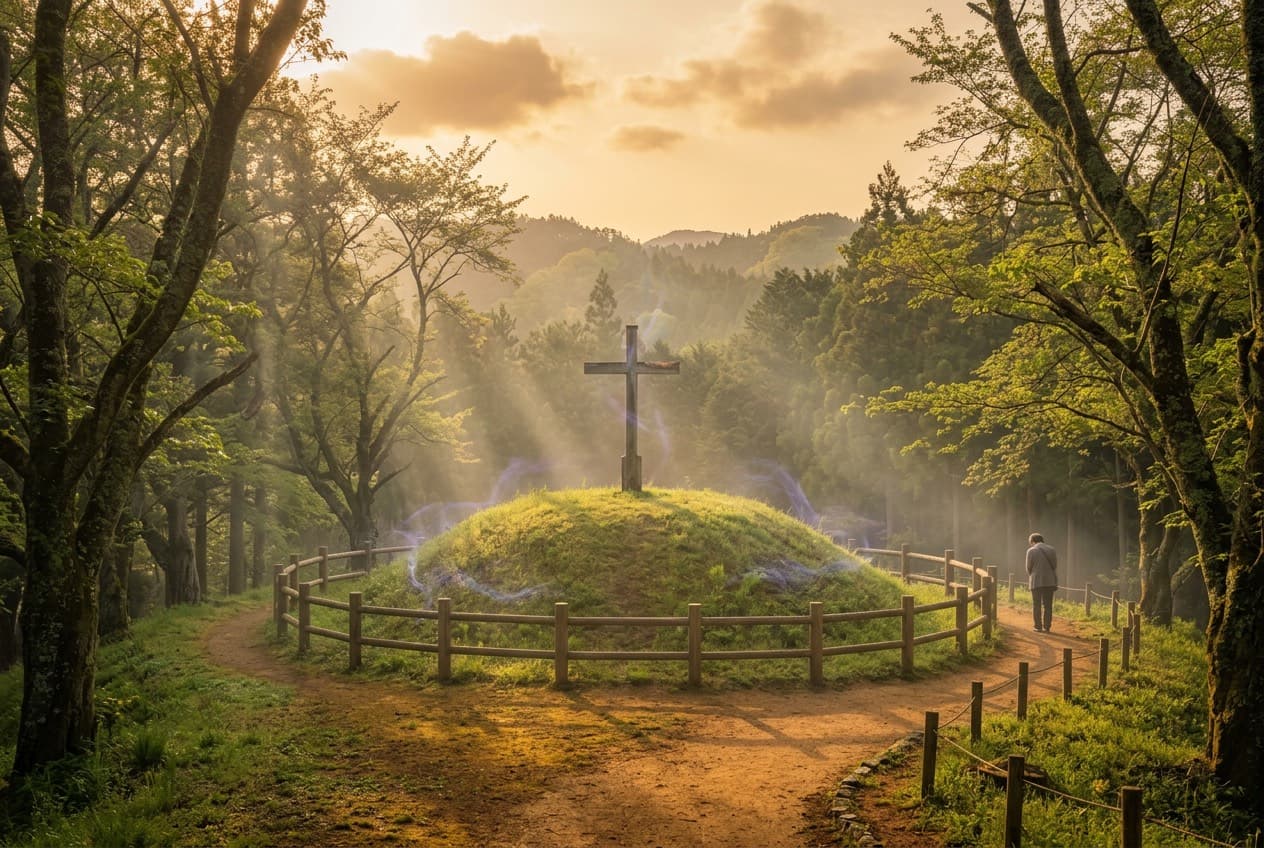
Nobody talks about Isukiri. Two thousand years of Christian theology, tens of thousands of books, centuries of art and argument and war — and the name Isukiri appears in none of it. He exists only in the Takenouchi Documents, which most scholars consider pseudohistorical at best, and in the legend that those documents spawned. According to that legend, Isukiri was the brother of Jesus. Not a metaphorical brother, not a fellow traveler, not a disciple promoted to family status by later tradition. A brother. Blood. The same mother. The same house in Nazareth, or close enough. And when the machinery of crucifixion began to close around Jesus — when the Temple authorities and the Roman governor and the crowd's appetite for a climax converged on a single point — Isukiri saw what was coming and made a decision that would vanish from the historical record for nearly two thousand years.
He took his brother's place. The legend does not explain the mechanics — legends are not interested in logistics. What the Takenouchi Documents say is that Isukiri died on the cross. That Jesus did not. That the most famous execution in human history was performed on the wrong man. And that matters — the entire structure of Western civilization pivots on that substitution. But it is not the most important thing about what Isukiri did. The most important thing is what happened to the consciousness inside his brother as it watched him die.
Sit with that for a moment. Do not rush past it to get to the next plot point. A man volunteered to be nailed to a piece of wood and suffocated to death in the sun so that his brother could live. Not in the abstract, inspirational, 'greater love hath no man' sense that Sunday school reduces sacrifice to. In the actual, physical, there-are-nails-going-through-your-wrists-and-you-are-going-to-hang-here-until-your-lungs-fill-with-fluid sense. Crucifixion was not a symbol when it was happening to you. It was a technology of pain so efficient that Rome used it for centuries precisely because nothing else communicated the message as clearly: this is what happens to people who disrupt the order. Isukiri did not volunteer for a symbol. He volunteered for the real thing.
Why? The legend does not give him a speech. It does not give him a Gethsemane moment of doubt and resolution. It does not provide the internal monologue that a modern novelist would consider essential. What it gives him instead is clarity — and something deeper than clarity. Isukiri saw what the crowds could not: that his brother was still, after thirty years in flesh, fundamentally an observer. A magnificent observer. A compassionate one. But an observer all the same. Still watching from behind his own eyes. Still approaching humanity as a mission rather than a family. And Isukiri understood — the way only a brother can understand — that the crucifixion would end the consciousness before its education was complete. It would die as an observer. It would never learn what it had incarnated to learn. But beneath the strategy, beneath the logistics of saving the mission to Shingo, there was something else. Something that could not be taught through parables or demonstrated through miracles. The only way to teach it was to do it. To die for someone. Not symbolically. For real. With nails. To show the consciousness what love actually was — not the concept, not the principle, but the full, devastating, irrevocable weight of it.
And it worked. Standing in the shadow of the cross — or watching from a distance, the legend is ambiguous, and the ambiguity is part of it — the consciousness felt something it had never felt before in its entire existence. Not observed. Not cataloged. Felt. Grief. Raw, annihilating, bone-deep grief that reorganized every other experience it had ever had the way gravity reorganizes space. The grief was not information. It was a wound. And the wound was the answer to the question the consciousness had been asking since before it had a body: what does it feel like to care about something you are guaranteed to lose? It feels like this. It feels like watching your brother hang on wood meant for you and knowing that he chose it, and knowing that the choice was love, and knowing that you will carry this moment inside your body for the rest of your life like shrapnel too close to the heart to remove.
Isukiri died on that cross. The consciousness survived. And in the space between those two facts — between the brother who died and the brother who lived — the entire meaning of the incarnation shifted. The consciousness had entered flesh to learn what it meant to be human. Isukiri's death was the final exam. Not a lesson in strategy or theology. A lesson in love. The first and only lesson that mattered. Love is not a concept you study from outside. Love is what happens when someone else's life becomes more important than your own. And Isukiri had just demonstrated that principle in the most extreme form available to a human body. The consciousness that walked away from Golgotha was not the same consciousness that had walked in. It had been broken open. It could feel now — really feel, not just sense, not just register, but feel with the full devastating weight of a human being who has lost someone irreplaceable. The wrong man died. The right man disappeared east, carrying a grief that would fuel a walk across the entire world. And the story that grew from that substitution — the resurrection, the church, the empires, the crusades, the cathedrals — was built on a misreading of an act of love so total that the world mistook it for theology.